Friday, September 23, 2011

Chinese demons, monsters and other beings

The Qilin. Its appearance is said
to herald the arrival of a great sage.
Welcome to Hell, human.

Here you will find a comprehensive list of demons, devils and assorted supernatural nasties - as they are known to the Chinese. This way, when you are blasted into the abyss by an evil sorcerer, you will have the names of your tormentors at your disposal! (As long as you have wi-fi access and remember to follow this blog.)

Read on, but first, as the saying goes: "报上名来, 免做无名之鬼!" (bào shàng míng lái, miǎn zuò wú míng zhī guǐ, "Tell me your name, so you will not be a nameless ghost! [after you are slain]")

Some of the creatures below are mentioned in the various "Novels of the Weird," (志怪小说 zhì guài xiǎo shuō), that gained popularity in the period of theWei, Jin, and Southern and Northern Dynasties (魏晋南北朝 wèi jìn nán běi cháo), roughly between 220-589 C.E.

During this time, Buddhism was becoming popular (having been introduced in the first century C.E.), Daoism was burgeoning, and Daoist and Confucian ideas were combined into a kind of metaphysical study known as 玄学 (xuán xué, literally "study of the mysterious"). Persian and Greek influences were also seeping into China, so the whole place was awash in myths, legends, superstition, religion and all things mystical and magical.

Other monsters are from the ancient text, the Shan Hai Jing (山海经 shān hǎi jīng), or "Classic of the Mountains and Seas." The author and date of this book are not known, but it is thought to be at least two thousand years old. It is more of a geography book than a list of creatures; it describes known and unknown areas of "China" (such as it was back then) and the inhabitants of those areas, some of whom are monsters.

Additional beings are described in the 4th-century tome, "In Search of Spirits" (搜神记 sōu shén jì) by Eastern Jin Dynasty Court Historian Gan Bao (干宝 gān bǎo). "In Search of Spirits"(or "Records of the Search for the Supernatural") is a compilation of stories and accounts of otherworldly creatures and encounters.

Behold! The Encyclopaedia Obscura de Daemona et Anima Orientalis!
(Apologies to anyone who actually knows Latin and/or Greek.)

- jīng - general term for spirit, or sprite. Also 精灵 jīng líng.

- guǐ - ghost. This is an important character in supernatural lore. It is part of a lot of other characters that have to do with ghasts, ghouls and ghosts, usually found on the left side of the character, e.g. 魑, 魃.

地狱 - dìyù - Hell. Lit. earth/underground prison. There are Buddhist, Daoist, and other interpretations of Hell, but most agree it is not a fun place to spend an afternoon.

- yāo - female demon. Also means "full-figured woman," which was apparently so rare back in ancient times that if you saw one she must be a demon. Common usage is 妖怪 (yāo guài), demon or ghost.

(also written ) - yù - Yu, a turtle-like creature that lurks in dark waters and attacks people by spitting sand at them. Sounds pretty annoying.

幽灵 - yōu líng - ghost, apparition. Literally "dark soul."

狐狸精 - húli jīng - fox spirit. These are typically attractive, female spirits who can assume human form and are generally associated with mischief. They can do magic and live for hundreds or thousands of years. Also used today as an insulting term for a man-stealing homewrecker.

蓝精灵 - lán jīng líng - Smurf. Okay, it's not a Chinese demon, but in Chinese it is literally, "blue spirit."


The legendary Nine-tailed Fox.
九尾狐 - jiǔ wěi hú - Nine-tailed fox. A magical creature that lives in the Qing Qiu Mountains. It "sounds like an infant and can eat people." (according to the Shan Hai Jing). Not to be confused with the "Cat-o-nine-tails."

魑魅 - chī mèi - Chimei, a malevolent demon that lives in the mountains. Don't make it angry.

恶魔 - è mó- demon. Fairly generic word for your basic run-of-the-mill evil demon or devil. Another similar word for demon is 恶煞 (è shà). The first part of both words is (è), which basically means "evil." Evil is made up of two parts: yà - (ugly) and xīn (heart).

- xiāo - Xiao, a one-footed mountain-dwelling fiend. It has one foot, a big head and a small body and attacks people at night. What a jerk.

The Kui
- Kuí - Kui. A one-legged demon of Chinese mythology. Not to be confused with the Xiao, but who knows how to tell the difference?

- bá - Ba, a powerful demigod that can cause droughts. Also known as "Han Ba," 旱魃 (hàn bá). (旱 hàn means drought). Not clear if it is a demon or an actual god.

无支祁 - wú zhī qí - Wu Zhiqi, an ape-like water demon. He is as strong as nine elephants, with a white head and green body. However, he is not much of a threat today since he was defeated and chained up by the legendary Yu the Great (大禹 Dà Yǔ), who lived in the 21st century BCE. Yu the Great is best known for Taming the Great Flood (but he was possibly just an irrigation specialist.)


Sun Wukong, the mischevious Monkey King
孙悟空 - Sūn Wùkōng - Sun Wukong, the Monkey King, the Great Sage, Equal to Heaven. Another famous monkey, Sun Wukong is the magical character from the Classic Novel "Journey to the West" (西遊記 - Xīyóujì). This book also features tons of demons and creatures, and really deserves its own post at some point. Sun Wukong was recruited to help the Tang Dynasty monk Xuan Zang (玄奘 Xuán Zàng) on his pilgrimage to India to retrieve Buddhist scriptures.


- jiān - Jian, a mythical bird with only one eye and one wing, so that only a pair of them can fly (often used in phrases to describe people who are in love and inseparable, eg: 鲽鹣 diéjiān - "a flounder and a Jian-bird," meaning a harmonious and affectionate couple. Um, okay.)

僵尸 - jiāng shī - zombie. Along with the noodle, gunpowder and the dumpling, China also claims it invented the zombie. According to Daoist lore, zombies are dead people whose "limbs are stiff, heads do not lower, eyes do not slant, legs do not separate, and the corpse does not rot." One account says the Yellow Emperor's daughter was cursed by the emperor's legendary rival Chi You, (蚩尤 Chī Yóu) and became a zombie.

Bai Ze

白泽 - baí zé - Bai Ze, a legendary beast-god. The Bai Ze resides in the Kunlun Mountains. Its entire body is white and it can speak human languages. It knows the name and appearance of every type of demon, monster and ghost in existence - and more importantly it knows how to defeat each one. He told this information to the Yellow Emperor (黃帝 Huángdì) in the 26th century BCE, who wrote them down in a book called the "Book of Bai Ze" (白泽图 bái zé tú). This book was lost long ago, but when it existed, it allegedly served as a kind of Field Guide to Monsters, (eat your heart out Gary Gygax) and people would carry it around so they could identify and fend off any supernatural foes they happened to run into.

貔貅 - pí xiū - Pixiu, a mythical hybrid creature that brings luck and wards off evil, having a dragon's head and a lion's body, often with hoofs, wings and tail, and covered in grey fur. It is an angry beast, due in large part to the fact that it has no anus. Doh! It can consume only money, but can't crap it out, so it is lucky to have one in your house. Or, at least a statue of one. If you come by a Pixiu statue, you should put a coin in its mouth and leave it there, for good luck. It will attract money from all over the place to eat. It is said to be one of the nine offspring of the dragon. It looks a lot like a Qilin, but only has one horn in the middle of its head.

麒麟 - qí lín - Qilin. (Same as Kirin, in Japanese, like the beer.) This sagatious chimera is mostly good, but will punish the wicked. It's depiction has varied over the centuries, but it generally has a dragon head with two horns, hooves, lion eyes, tiger back, bear waist, and snake scales. It is the steed of the gods and can fly. One theory is that it was an early name for a giraffe, probably before anyone had actually seen one, although admittedly giraffes are insane looking.

獬豸 - xiè zhì - Xiezhi. A guardian beast-god similar to the Qilin, but with black fur, and only one horn. It can speak human languages and is able to sense good and evil. It will seek out corrupt government officials, after which it impales them with its horn and eats them. Must be extinct.

女娲 - Nǚwā - Nu Wa, not really a beast, but the creator of humanity. A strange serpent-bodied woman, associated with Fuxi (伏羲 fúxī) the male half of the creator of humanity who may or may not be Nu Wa's brother. No wonder the world is so screwed up.

鷫鸘 - sù shuāng - Su Shuang. One of the god-birds of the Five Directions, the Su Shuang resides in the West. It has a long neck, is green and resembles a wild goose, but it can turn its feathers to fur.

魍魉 - wǎngliǎng - A fairy monster that lives in mountains and streams.

- péng – Peng bird. A huge mythical bird, similar to the Roc. Sometimes used in people's names so you think they are a badass.

Wow. As I research these things, more and more seem to crop up. That is it for now. Please comment if you can think of any more I should include. Thanks for reading!

Tuesday, June 7, 2011

Chomping Thru China: Where to eat in Beijing

Welcome to Chomping Thru China, (中国食记, Zhōng​guó​ shí​ jì) a three-part travelogue about where to eat in different cities in China! This is not a comprehensive guide, it is more just a bunch of places we ate at and liked on our recent visit to China. Get ready for some major taste-bud envy. First up: Beijing!

Black Sesame Kitchen
3 Black Sesame Hutong,
Dongcheng District, Beijing, China 100009

After a full day of going through three boxes of my crap at my friend Rao Shan's parents' house that had been there gathering dust for the last decade, we set out for my Journalism School classmate, Jen Lin-Liu's restaurant/cooking school in the heart of Beijing's old city.

Black Sesame Kitchen (黑芝麻厨房 hēi​zhī​ma​ chú​fáng) is not easy to find, but it is worth the search. The restaurant is in the back of a renovated courtyard in one of Beijing's dwindling historic alleyways. I found this fascinating, because when I left in 1999, a foreigner operating a business in an old hutong would have been difficult to pull off at best, if not impossible (as far as I know). Jen's place turned out to be the first of three surprisingly delightful culinary and brewtastic finds that we came across in the alleyways.

Beijing is famous for its ancient alleys, known as "hutongs," (胡同, hútòng)​. The hutongs date from the Yuan Dynasty (1271-1368) and some have cool, whimsical names like Silver Bowl hutong, Chicken Claw hutong, and Big Tea Leaf hutong (where I lived for a little while). Jen's place was in - where else? Black Sesame hutong (黑芝麻胡同 hēi​zhī​ma​ hú​tòng), No. 3 to be exact.

You have to contact BSK ahead of time to make a reservation either for dinner or actual cooking classes. In true last-minute style (and encouraged by my mom), I emailed Jen from the airport in San Francisco a few hours before we left for Beijing to see if she was around. She was nice enough to set us up with a special reservation on short notice and she signed us up for the awesome 10-course dinner complete with wine and the ever-popular Yanjing beer (燕京啤酒 Yān​jīng pí​jiǔ). The food was prepared in sight by Jen's former cooking teachers, and it was a sampling of some traditional favorites as well as some more creative options. Here is a quick look at what we had:

- Pork and pumpkin potstickers (猪肉南瓜锅贴 zhū​ròu nán​guā guō​tiē)
- Fried shiitake mushrooms with coriander and carrots (素炒膳丝 sù​ chǎo​ shàn​ sī)
- Flash fried lamb with leeks (葱爆羊肉 cōng bào​ yáng​ròu)
- Red-braised eggplant (红烧茄子 hóng​ shāo ​qié​zi)
- Wok fried string beans (干炒豆角 gān chǎo​ dòu​jiǎo)
- Red-braised pork belly (红烧肉 hóng​ shāo ​ròu)
- Garlic broccoli with goji berries (蒜蓉西兰花 suàn​ róng​ xī​lán​huā)
- Cashew kung-pao chicken (宫保鸡丁 gōng​bǎo​ jī​dīng)
- Pine nut beef stir fry (松仁牛肉 sōng​rén​ niú​ròu)
- And for dessert: Candied sweet potato with sweet cream (拔丝红薯 bá​sī​ hóng​shǔ)

If you just said "holy crap" (我靠 wǒ​kào) in your head you are well-justified. It was a ton of food for the four of us but we devoured most of it. My favorite were the potstickers. I love those anyway, but the pumpkin gave the filling a delectable creaminess that was a nice twist on the normal version. The crispy fried shiitakes with coriander were also outstanding, I thought.

The sweet potatoes were coated in hot liquid caramel, so you grab a piece with your chopsticks and dunk it in the ice cream to cool it off. This creates long strands of caramel as you pull it off the plate (which is why the dish is called 拔丝, bá​ sī: "pulling threads") and then it makes a shell of solidified sugar as the cream cools it off. Really yummy. I'd be remiss if I didn't also plug Jen's book, "Serve the People: A stir-fried journey through China," which is a great memoir of her time learning to cook all over the country (complete with recipes). The fact that she was in town when we were was pure serendipity, since she was back only briefly before returning to the Silk Road gathering material for another book.

Shunfeng 123
Worker's Stadium, West Gate
Chaoyang District, Beijing

My friend Rao, whose parents were keeping my stuff, organized a mini-reunion of some of our classmates from the no-longer-existent Foreign Language Normal College (外语师范学院, wài​yǔ shī​fàn ​xué​yuàn) where I first went to China for a semester abroad in 1992. It was fun to see these guys, some of who were dorky romantics back in the day, now all grown up and organized with wives and jobs. But they still had a taste for fun and hanging out drinking the local Beijing swill, Er Guo Tou (二锅头 èrguōtóu), a 112-proof liquor loved by all for its extremely favorable cost-to-inebriation ratio.

I remembered that when I first met these guys, we were instructed by the school leaders not to discuss politics of any kind, and we were not to be seen walking around on the street with them (presumably to keep them from getting in trouble). Now of course, we can talk about anything and they can feel confident hanging out with morally bankrupt foreigners such as myself.

Rao set us up with a huge table at a restaurant that he is actually part owner of, called Shun Feng 123 (顺风 123, shùn​fēng yī èr sān). This place is well-known for its Sichuan cuisine, and is an upscale joint just inside the western entrance to the Worker's Stadium (工人体育场 gōng​rén​ tǐ​yù​chǎng).

I did not keep track of all the dishes we had here, but I remember everything I had was really good. We were too busy reminiscing and drinking Er Guo Tou and making fun of each other. I do remember a spicy frog dish (I let that slide by on the lazy susan), and of course Ma Po Tofu, (麻婆豆腐 má​pó​ dòu​fǔ) a classic Sichuan favorite. One feature of Sichuan dishes is the presence of a spice called Sichuan peppercorn, or sometimes prickly ash (花椒 huā​jiāo). It is a strange spice that basically makes your tongue and mouth numb. An acquired taste, but very unique and not to be missed.

After ShunFeng 123, a few of us headed to a bar, Frank's Place, nearby. This place was interesting in that it showed the international side of Beijing, where you could - almost - be anywhere in the world. We ordered Guinness, french fries, and chatted over heavy wooden pub tables. There were a few touches that let you know you were not in College Town, USA. First, you could smoke inside. Second, while the Guinness was a respectable 8-9 bucks, a bottle of Pabst Blue Ribbon cost a mind-boggling $91 - that's US dollars mind you. We tried to figure out what the deal was, but no one had a good explanation. Someone should find out who PBR's marketing director for Asia is and hire them to do pretty much anything. Admittedly, it is not your average PBR tall-boy. It's called "Pabst Blue Ribbon 1844" and is a special brew only sold in China which comes in a fancy bottle. Still. It's PBR. Come on, China.


Great Leap Brewery and Hutong Pizza
Brewery: 6 Doujiao Hutong
Dongcheng District, Beijing
Pizza: 9 Yinding Qiao Hutong,
Dongcheng District, Beijing

While at the Black Sesame Kitchen, we were alerted to the presence of a real novelty, a Beijing microbrewery. After a morning at the Summer Palace, (颐和园, yí​hé​yuán), where my friend Mark and I procured awesome panda hats (see photo), we high-tailed it back to Dongcheng District to find the place: Great Leap Brewery. This was another hutong gem, located in Doujiao (Bean) Hutong (豆角胡同, dòu​jiǎo hútòng), in a courtyard behind a large steel door, engraved with the words "Great Leap Beer" (大跃啤酒 dà​yuè pí​jiǔ). While the name seemed kind of distasteful, the beer was quite the opposite. The name undoubtedly refers to the "Great Leap Forward," (大跃进 dà ​yuè ​jìn), a political movement in China from 1958-1960 in which an estimated 30 million people starved to death. Mao had decided that drastic steps were needed to propel China into a full-blown Communist powerhouse, so he made everyone melt their metal items to produce "steel" in furnaces that burned everything people could get their hands on including their front doors. Meanwhile, idiotic agricultural techniques were enforced and tons of crops failed or were left to rot. ANYWAY, who knows what the owner was thinking, but like I said the beer was good.


The most distinctive was the Honey Ma Gold, which used the aforementioned Prickly Ash spice to create a little tingle in the aftertaste. They also had a decent porter and the IPA was tasty as well. We had to ask directions to the place, and the guy who led us to it was a local, but had never been in there. One of the staff (an American girl) said locals come by and check it out but don't really get the concept of a microbrewery.

"They either come by and bum a cigarette and leave, or else ask for the strongest, most expensive beer we have," she said.

While we were there, the hostess recommended "Hutong Pizza" (胡同比萨 hú​tòng​ bǐ​sà) for a food choice. We got veggie and meat 'zas, both of which were pretty good. They sure went well with the beers. Crust was a little dry, but overall it was enjoyable, and it was delivered to the brewery, which was key for hungry pandas.

Xian'r Lao Man
252 Andingmen Nei Dajie
Dongcheng District, Beijing


"Not to be missed" is all I can say about this place. Just a few blocks away from the Buddhist Lama Temple (雍和宫 Yōng​hé​ Gōng), Xian'r Lao Man (馅老满 xiàn'r​ lǎo mǎn) is a well-known dumpling restaurant, with dozens of types of dumpling fillings to choose from. The first part of the place's name, Xiàn'r (馅) means filling. It is actually "xian" but since you are in Beijing you have to add the "er" at the end to be authentic in your accent. Being able to read (and speak) Chinese here is a must, otherwise you are stuck looking at the picture-menu, which does not help with the dumplings and only minimally with the other dishes.

You can order a minimum of 10 of each type of dumpling (饺子 jiǎo​zi), and you can either have them steamed or fried. We ordered fillings of egg and chives (鸡蛋韭菜 jī​dàn jiǔ​cài), beef and fennel (牛肉茴香 niú​ròu​ huí​xiāng), the Xianr Lao Man special filling (probably pork, egg, cabbage, shrimp and something), and cilantro and pork (香菜猪肉 xiāng​cài zhū​ròu) (if memory serves). Not only are the dumplings delicious here, the other food is terrific too. But don't just take my word for it (<--links to fun foodie blog Beijing Haochi). We also ordered a plate of kung pao chicken and a bunch of other stuff including the yummy cold-dressed dried tofu strips (凉拌腐竹 liáng​bàn​ fǔ​zhú). Oh and the Beijing favorite, Noodles in Fermented Soy Bean Paste (炸酱面 zhà​jiàng​miàn). So good. We also had a fiesty, cute waitress who served us up with a healthy portion of studied indifference. I was barked at when I asked her for an extra bowl.

That about wraps it up for Beijing. Stay tuned for the next installment, Chomping Thru China: Shanghai!

If you have any other thoughts about favorite restaurants, post them below, and thanks for reading!

Saturday, April 30, 2011

Scroll deciphered (mostly)


For our wedding, we received a beautiful antique-looking scroll (right) from a good family friend. The scroll is on yellowed paper, and shows a condor (eagle? vulture?) sitting on a tree branch and looking to the side with some calligraphy on the right side. There was not too much information about it, and we finally hung it up in the stairwell so I decided to do some research.

I could make out most of the first line of the poem, so I went and googled it. Turns out the poem was written by a Yuan Dynasty poet, Chen Ruzhi (陈汝秩 Chén Rúzhì), who died in 1385. There is little information on this guy besides that he was a poet and calligrapher and painter. His brother, Chen Ruyan (陈汝言, Chén Rúyán​) may have been more successful since there is one of his landscape paintings in the Cleveland Museum of Art. All of the cool Chinese kids get their paintings in there after all. After some Googlage, I found out the poem says:

晚风吹雨过林庐
柿叶飘红手自书
无限潇潇江海意
一樽相对忆鲈鱼


(wǎn fēng chuī yǔ guò lín lú
shì yè piāo hóng shǒu zì shū
wú xiàn xiāo xiāo jiāng hǎi yì
yī zūn xiāng duì yì lú yú)

I am probably missing a lot of nuances here, but for what its worth, my translation is:

"The evening wind blows rain through the forest hut
Persimmon leaves blow red as my hand writes calligraphy
The limitless sounds convey the meanings of the rivers and seas
A jug of wine to face recollections of perch."

Ruzhi lived at the end of the Yuan and beginning of the Ming dynasties, in the 14th century. I can only wonder if "recollections of perch" is some kind of pun or political allegory, because otherwise it is slightly strange. Of course in the grand tradition of writing poetry, he was most likely hammered (hence the "jug of wine"). Personally I like the line, because I do have fond memories of fishing with my brothers and dad at Lake Champlain and catching perch - and pickerel and pike.

It is not clear when he wrote the poem, but his brother Ruyan was killed by imperial forces at the beginning of the Ming Dynasty after having served with the famous rebel leader Zhang Shicheng (张士诚 Zhāng Shìchéng). Zhang rose up against the Mongols of the Yuan, but was not successful enough to start his own dynasty and was defeated by the dude (Zhu Yuanzhang 朱元璋 Zhū​ Yuán​zhāng) who ultimately started the Ming Dynasty in 1368.​ So perhaps the perch reference has something to do with that. Unknown.

ANYWAY, that is not to suggest that this scroll was painted or written in the 1300s, but the poem is from then. There is a name at the end of the poem, but I can't read it so I don't have a good way to find out much more.... for now. Stay tuned! Or if you have an idea let me know. Here is a closeup, the 2 characters above the red seals. Maybe it is a year designation?

UPDATE: I believe the first character is (kuí) meaning sunflower, also a rare surname. According to Baidu, people with the Chinese surname Kui account for 0.005% of the population, or about 60,000 people, mostly in Henan Province. That narrows it down a little!

葵 is also "Aoi," a Japanese name. Hmm.

ANOTHER UPDATE: OK, I think I got it, although it does not answer the real question of who painted this and when. I think the characters say Kuitang (葵塘 kuítáng), which is a small town in either Guangdong Province, or there is also one in Guangxi Autonomous Region, could be either one.

Wednesday, April 6, 2011

China: At last!


After 12 years, I finally returned to China for a two-week visit! Michala and I met up with our friends Mark and Lisa for an awesome time hitting Beijing, Shanghai, and Xiamen with them before M and I moved on to the small city of Yangshuo (阳朔, Yáng​shuò​) in Guangxi Zhuang autonomous region ​(廣西壯族自治區Guǎng​xī​ Zhuàng​zú ​zì​zhì​qū).


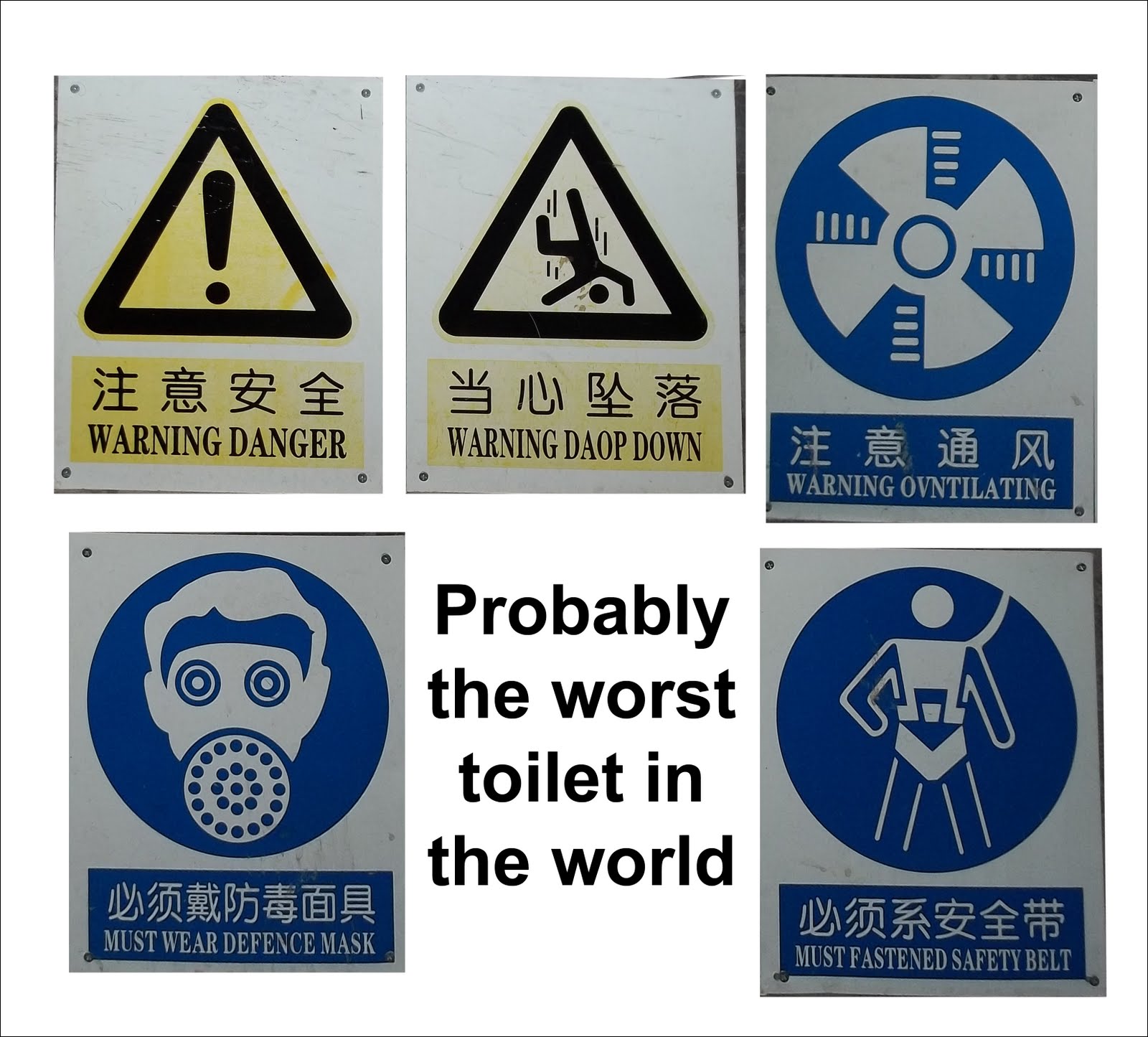
It is hard to sum up in a few sentences the feeling of returning to China after so long, but suffice it to say that it felt like going home, like going for the first time, like digging around in my past, and like opening a window on the future. As always it is place of great contrasts. Take these two photos for example. Above: A detail from the Great Wall (cháng ​chéng, ​长城) at Mutianyu (Mùtiányù, 慕田峪). Majestic, beautiful, full of history and intrigue, a place of solitude and somewhere I could probably go everyday. Then, on the other end of the spectrum - this apocalypse-ready signage, seen on the side of a public bathroom in an alleyway (My caption). Slightly ridiculous, kind of gross, and frankly a bit frightening.


My only guess is that the signs were placed there ahead of the Olympics, in order to discourage foreigners from going in there - without their gas masks and safety harness, which in theory will prevent you from the "Daop down" into the cesspits in case of catastrophic failure of the "Ovntilating" system.


In spite of the bathroom situation, and the eternal search of my comrades for what we called a "Western deucer," we all had a good time. More evidence I had been gone a long time appeared in the form of Beijing traffic. When I left in 1999, there were three ring roads around the city, with a fourth being constructed. Today there are six, with the Sixth Ring Road (六环路, liù huán lù) having a circumference of about 200 km. Apparently a seventh is on the way. The traffic was also terrible. It took forever to get anywhere by taxi and some cabbies even flat out refused to take us certain places during rush hour.


One important thing I did in Beijing was to retrieve my trumpet. I had left a bunch of stuff (3 boxes worth) at my friend's house. Among these boxes of mostly junk was my trumpet, a nice nickel silver horn that I have had since grade school. It is a beauty and it was fun to reunite with it, although I need to get it cleaned.


Shanghai was like an alien spaceport. I had never spent much time there, but it had obviously changed a lot. For one thing the buildings all had ads on them. I don't mean billboards, I mean entire buildings that were 60-100 stories tall lit up and ads and graphics danced across the surface as millions of tiny lights on the sides of the buildings, acting like huge monitors.


I'd never been to Xiamen (厦门, Xià​mén) ​before, and we only stayed there for one full day. The main thing we saw there was Gulangyu (鼓浪屿, Gǔlàngyǔ)​, which was a small island, near the city of Xiamen, which is also an island.


There was a funny scene where I purchased tickets for the "ferry" across to Gulangyu. I paid for the tickets, but received no tickets. The girl came out of the ticket office and led us to a dock where there sat a large Mark-Twain-ish style river boat, which we approached and got ready to board. "No that's the boat that goes around the island," she said.


She led us to the other side of he dock, where there was some kind of tug boat or fishing rig, maybe 30 feet long. We shrugged as the woman indicated we should get on. Not as good as the other boat, but OK, we were all up for the experience. Then she says we should keep going! So we walked across the deck where there was a small 12-foot motor boat with a teenager behind the wheel. "That's your boat," she said. Fortunately the ride was only about 30 seconds long and waters were fairly calm.


After Xiamen, Mark and Lisa rejoined their cruise, and M and I went on to Yangshuo in Guangxi. This is a spectacular place to visit, for the weird, tree covered limestone karst mountains that are everywhere. More on that place later!


In all, it was a great trip. I had sort of assumed that the China chapter of my life was complete, but now I am not so sure. It is still a fascinating country, and the fact that my spoken Mandarin was still in good shape was encouraging. The fact that Michala liked it there and had a good time was also a good sign for future dealings with the place. We also met up with several friends that I had not seen in years, so that was also great to re-activate those relationships.


Mark summed it up nicely, when I was talking about having not been back for so long. He said: "It was time." I owe a special thanks to Mark and Lisa for making the trip actually happen. I guess we'll see what the future brings. Looking forward to more trips to the dynamic, wacky, frustrating and inspiring, ancient and modern country of China, land of contrasts. As I write, things are springing to mind, so hopefully more detailed posts will follow in the not too distant future.

Wednesday, February 9, 2011

Been a long time since I blogged and rolled


Me: Forgive me Blogger, for I have sinned. It has been like four months since my last blog session.

Blog: Infidel! How dare you ignore me? Have two Bloody Marys and say one Our Blogger and you are forgiven. In nomini blogii y googlii y webus sanctii, amen.

OK, now that I got that out of the way, here is my new blog post.

Recently I found out that my friend Dewey Webster is working on the Seattle Chinese Garden. This project is really cool. It is an effort to construct an authentic Chinese garden and courtyards in Seattle.

Of course no Chinese courtyard is without that staple of Occidental entryways: the couplet. Oftentimes on either side of an entryway to a courtyard or other doorway, you will see plaques with vertical lines of writing on them. The couplets are poems that are supposed to say something about the place they are hung at.

Dewey sent me pictures of the various couplets, as well as the overhead plaques that say what area you are entering, and asked if I wanted to take a crack at translating some of them. How could I resist? Not only is it a great reason to update the blog, it is a way to be a part of a cool project. So, here are the couplets.


Note: The plaques are written traditionally, right to left, and top to bottom. For my own intense porpoises, I have converted to regular left to right.


西华园
Xi Hua Yuan
Looks simple enough, right? Wrong! Literally this says Western Glory Garden. However, the “western” refers not only to the West as in the USA, but Seattle, whose Chinese name is “西 Xi Ya Tu.” This is a phonetic translation, which literally means Picture of Western Grace. I have also heard a take-off transliteration of Seattle : “si ya tou,” which honestly sounds closer phonetically, but it means “dead slave girl” so for some reason it fell out of favor with the locals.
The word 华, glory, also means “China,” so the place is called West Glory Garden, but also Seattle-China Garden.

On either side of this entrance is the following couplet:
Right side:
西窗烛剪巴山雨 (xī chuāng zhú jiǎn bā shān yǔ)
This took me a while to figure out. Basically it says
"Cutting candles by the Western window, the rain over Ba Mountain."
Ba Mountain seems to refer to Sichuan. The reason I say that is because of this old poem by Tang Dynasty poet Li Shangyin (李商隐), upon which the couplet seems to be based:

君问归期未有期 (jūn wèn guī qī wèi yǒu qī)
巴山夜雨涨秋池 (bā shān yè yǔ zhǎng qiū chí)
何当共剪西窗烛 (hé dāng gòng jiǎn xī chuāng zhú)
却话巴山夜雨时 (què huà bā shān yè yǔ shí)

You ask when will I return, but I don't know,
The night rain of Ba Shan fills autumnal pools.
When will we be together again, clipping candles in the Western window,
So we can talk about the night rain of Ba Shan?

Not to be confused with 巴山夜雨 "Evening Rain" a movie from the 1980s about the Cultural Revolution.

Left side:
华萼香漂海国春 (huá è xiāng piāo hǎi guó chūn)
"The fragrance of Chinese flowers drifts into spring overseas"
This was interesting because like I said before 华 (hua2) means both "flower," glorious" and is also short for "China." The whole theme of this garden is the confluence of China and the USA. After all, Chongqing is the sister city of Seattle. So it could be "Glorious flowers" but I say "Chinese flowers." The other pun here is 海国 (hai3 guo2). 海 means "ocean" and 国 means "country," so together they could mean "overseas." But consider the word "Sea-attle." The Sea-Country.

End of Part One (in the interest of posting once before I return to China in March!)

Thursday, October 14, 2010

From the archives

I just came back from visiting my mom and while there I came across an amazing archaeological find from the year 1996!

That year, I was living in China, working as a "foreign expert" (外国专家 wài guó zhuān jiā) at the magazine "China Today" (今日中国, jīn rì zhōng guó). I was also studying kungfu (功夫, gōng​ fu​) with an informal class that met under a bridge in Beijing. One of my classmates there was a student at Beijing Film Institute, and mentioned that a film crew from Beijing Television was looking for a few foreigners to be in a TV show about the Long March (长征, cháng zhēng). It was the 60th anniversary of the end of the Long March, which was a massive military retreat across 10,000 km of Chinese countryside by the Red Army (红军, hóng jūn), as they were evading the Nationalists, aka KMT or Kuomintang (国民党, guó mín dǎng).

Never one to turn down weird opportunities, I agreed and went to check it out.

The result was a 40 day journey into the heart of rural China, complete with film crew drama, wacky drunken dinners, loads of propaganda and a cute panda named Didi.

This time visiting my mom, not only did we discover the tape of the show that finally aired on BTV, Mom found my journal from the trip, which I had assumed was lost with the rest of my stuff which I left at my friend's house when I left China in 1999. Needless to say I will try to write this up as an anecdote. Here is a teaser:

On the way to the chain bridge crossing (泸定桥 lú dìng qiáo), we decided to stop by the Wolong Nature Preserve (卧龙自然保护区, wò lóng zì rán bǎo hù qū). It wasn’t actually part of the Long March, but everyone was tired and we all needed to do something fun. The other option, actually more tempting, was to visit Jiuzhaigou (九寨沟, jiǔ zhài gōu) a truly wild place, with basically no people. Several tourists are lost there each year, it was said.

But Wolong turned out to be one of the most memorable places we visited. The cages and offices were not very upscale, and it was really a question of not having enough money. But you could tell that the guys who worked in the place really cared for the bears. They had their protein cookies and milk porridge, and they all had names.

The main caretaker warned us not to reach into the cages, because although the pandas look very cute, they can be violent. He said that a tourist came to Wolong a few years ago and tried to play with a panda—and got half his face ripped off by the big teddy bear.

But there was one panda on the premises who had been brought up in captivity so was fairly docile and familiar with people. Her name was Didi.

The most exciting part was when we were allowed into the cage with Didi. There she was, sitting on her concrete pedestal, holding a stalk of bamboo and munching to her heart’s content. She looked harmless enough. Actually she was the cutest thing I had ever seen. The keeper was very specific in his instructions about what we could and could not do.

“ONLY pet her on the back, and from top to bottom,” he said.

But the reality of the situation was much more difficult than that. When you are standing in a cage with a panda bear, you realize how unbelievably cute and cuddly they really are. Didi was about four feet high while sitting, and she sat just like a teddy bear, with pads facing out, sitting up, and front paws grasping the bamboo shoots.
I maneuvered around back of her, and the guy gave me the OK to begin petting. Her fur was a little oily. I noticed her ears, round furry medallions that needed a scratch, and would just fit in the round part of my hand. My hand drifted up toward her head…
“Don’t touch the ears!” the guy yelled into the cage.

All right, all right. I moved my hand down her back. But then her paws were so inviting, the scaly pads and furry toes called to my fingers. Surely, if I just …
“Don’t touch her paws!” he snapped.

Grinning like an idiot, I went back to her back, but then it was time for me to get out of the cage. I posed for one last picture with Didi, and then I had to say goodbye. She seemed completely unfazed and continued chewing her bamboo. I left the cage but I will never forget her and her beautiful, forbidden ears.

Thursday, August 5, 2010

Animal House 2: Circling the dragon, whale sharks and wild dogs

In addition to my duties learning about the various nasty things that can happen to your dog or cat (or bird) at the American Veterinary Medical Association (AVMA) convention recently in Atlanta, Ga., I took the small luxury of attending a few extra-curricular classes on aquatic life, an endangered species, and animal acupuncture.

FOUS: Fishes Of Unusual Size
Trixie is 25 feet long, weighs 2,000 kilograms, and doesn't like to go in the stretcher for her medical check-ups. She came from Taiwan in a giant 25,000-pound ziploc bag filled with water. (Not really, it was a high-tech UPS container). I learned about her and the Georgia Aquarium's three other whale sharks: Yu Shan, Taroko and Alice at a session called "Whale Shark Care."

These creatures, the largest of the sharks, can grow to over 60 feet long and require 2,000 gallons of the anesthetic agent MS 222 delivered by a machine called Mega S.N.U.Z. in order to do anything to them. This includes gill slit checks; blood collection; and the all-important "vent flush." They can fully retract their eye to the point where it looks like they don't have one, and the four animals at the Georgia Aquarium are the only ones on display outside of Asia.

It was cool to learn about them, but even better was a fundraiser later that night at the aquarium where I got to see these things up close. They are very large, and walking through an acrylic tube at the bottom of the 6.3-million gallon tank, sipping a glass of wine while Trixie and company floated by overhead was pretty awesome.

Acupuncture: Not just fluffy needles
Having recently embarked upon my own acupuncture (针灸, zhēn​ jiǔ​) adventure for a knee problem, I was curious to see what the veterinary world had to say about the ancient technique. I admit I was expecting some vague, new-agey stuff about animal meridians, but I soon found myself scratching my head over a detailed scientific lecture.

I learned that this 4,000-year-old technique of stimulating points along the body reduces production of Substance P, which is a neuropeptide that plays a key role in the up-regulation of the inflammatory cascade and helps transmit pain signals to the brain. (I think P stands for Pain). Acupuncture also deactivates parts of the limbic system, which is linked to the emotional aspect of pain. Acupuncture reduces the presence of certain excitatory neurotransmitters (神经递质, shén jīng dì zhì ) in the dorsal horn of the spinal cord (part of the grey matter inside the spinal cord that helps transmit pain signals). And last but not least, when they stick the little needles in you (or your pup) it releases awesome things called endogenous opioids. Those make you feel good.

Like lots of things in science and medicine, nobody seems to know exactly how it works, but it does. This includes the process of "circling the dragon," which is placing the acupuncture needles around the wound or painful area and (optionally) electrifying the needles. I had this done to my knee as well, and while weird, it did help reduce swelling and pain for a while.

Let's get wild, dogs
Another session I went to was on the endangered species known as the African Wild Dog (非洲野狗, fēi zhōu yě gǒu). Like I mentioned in my post about the Asiatic Wild Ass, the "Wild" is said as if it were the first part of an adjective, "wild-dog." These are one of the only canids (dog-like) animals in Africa, and they have giant ears and they are super fast runners. (Hyenas are in their own category, they are not canids).

Wild Dogs mainly eat impala ("the hamburger of the Okavanga Delta"), and only about 3,000-5,000 Wild Dogs are still left in the wild. The Wild Dogs are one of the most efficient and successful hunters in Africa.
They have a 44% success rate on their hunts (really good considering the others: lion: 27%; hyena: 35%; and the cheetah: a dismal 4%!), and they can kill a wild wart hog in 30 seconds. They are very social and take care of their very young and old pack members (by puking up impala back at the homestead for them), but despite that they are hated by people, even though there has never been a reported attack on a human. Even lions hate them and will leave a kill (which they rarely do) to go and kill a Wild Dog. Jerks. Hopefully the Wild Dog will survive and make a comeback. Everyone loves an Underdog Wild Dog.

Finally, not to be too morbid, I went to a few sessions on animal hospice care. Yes, they have that. I just have to mention it because of one session: "creative euthanasia techniques." I imagined all kinds of crazy Rube Goldberg death apparatuses and lethal cocktails and stuff, but the presenter mostly talked about how to handle clients' grief and being accommodating about where they want to do it (like in their minivan in one case, since the dog loved the minivan.) The presenter was very cool and good and was all about doing the right thing in terms of euthanasia. She said: "The last thing I want is for the patient to have a bad experience with me before going to Heaven. Who knows who they're gonna talk to?"

Oh yeah, and there is a euthanasia drug marketed as "Fatal Plus." What would the advertising jingle be for that? The next conference is in January. We'll have to see what zany topics come up there. Stay tuned!