Wednesday, March 27, 2013

Chinese nursery rhymes!


Over the last few months I have been learning some Chinese nursery rhymes (童谣 tóng​ yáo) ​and children's songs to sing to Liam. Obviously it has taken some time since I have not blogged for many months!

Here are a few favorites, with my attempt at making translations that are fairly accurate and (occasionally) rhyme in English:


小白兔 Little White Bunny
This is the first rhyme I said to Liam in Chinese. I found it online and thought it was cute. Liam's reaction was that of mild distractedness.

小白兔,白又白,
xiǎo bái tù, bái yòu bái,

两只耳朵竖起来,
liǎng zhī ěr duo shù qĭ lái,

爱吃萝卜爱吃菜,
ài chī luó bo ài chī cài,

蹦蹦跳跳真可爱。
bèng bèng tiào tiào zhēn kě ài.  

Translation:
Little white bunny, oh so white
Two little ears that stand upright
He'll eat carrots, veggies too
Jumping, hopping, cute-a-lee-doo!
(I know, "cute-a-lee-doo" is not a real word.)

摇到外婆桥 Grandma's Bridge
This is kind of a Chinese "row your boat" song. The verse below is just one of the many versions/verses.

摇啊摇,摇啊摇
yáo a yáo, yáo a yáo

船儿摇到外婆桥
chuán'er yáo dào wài pó qiáo

外婆说好宝宝
wài pó shuō hǎo bǎo bao

外婆给我一块糕
wài pó gěi wǒ yī kuài gāo

Translation:
Row-a-row, row-a-row
To Grandma's Bridge our boat will go
Grandma says, good baby
Grandma gives some cake to me.

 
三轮车 Tricycle
Not the tricycle in the "Big Wheels" sense, more of a three-wheeled bike with a big platform on the back, usually piled high with vegetables, scrap iron, pig carcasses, etc.

三轮车 跑的快
sān lún chē páo de kuài

上面坐个老太太
shàng miàn zuò ge lǎo tài tai

要五毛给一块
yào wǔ máo gěi yī kuài

你说奇怪不奇怪
nǐ shuō qí guài bù qí guài

Translation:

The tricycle is real speedy
Ridden by an old lady
Asked for a nickel, got a buck
Isn't that just my luck?
(I played it kind of loose with this translation. The last line is more like "Isn't that weird?")


卖油条 Selling donuts
Chinese street donuts are not like Krispy Kremes. They are stretched out pieces of dough thrown into a pot of boiling oil, best enjoyed hot and dunked in a bowl of fresh soy milk. Yum!

街头巷尾 卖油条
jiē tóu xiàng wěi mài yóu tiáo

卖来卖去 卖不了
mài lái mài qù mài bú diào

哗啦啦啦啦啦
huā lā lā lā lā lā

变成老油条
biàn chéng lǎo yóu tiáo

Translation:
Selling donuts all over town
They sell and sell but never run out
La la la la la la
They become old donuts.
(I couldn't think of a good way to rhyme this.)


數字歌 Counting Song (shù zì gē)
This is a nice little song that teaches you to count to ten. Kind of like "One, two, Freddie's coming for you..." from Nightmare on Elm Street, but not scary.

一二三,爬上山
yī ér sǎn, pà shàng shān

四五六,翻跟头
sì wǔ liù, fān gēn tou

七八九,拍皮球
qī bā jiǔ, pāi pí qiú

伸出两只手
Shēn chū liǎng zhī shǒu

十个手指头
shí gè shǒu zhǐ tou

Translation:
1,2,3, climb the mountain
4,5,6, do a somersault
7,8,9, bounce a ball
Put out your two hands
Ten fingers!
(No way this can rhyme without changing the meaning entirely)

That's it for now. See you in another six months!

Monday, June 25, 2012

The most awesome tomb ever


The fabled tomb of Qin Shihuang might look like this.
(from China Cultural Heritage)
Ancient tombs and burial treasures are awesome.

Booby traps and diabolical machines are awesome.

So it goes without saying that ancient, booby-trapped tombs filled with treasure and diabolical machines are absolutely, mind-numbingly awesomely awesome!

Such is the tomb of China's first emperor, Qin Shihuang (秦始皇 Qín​ Shǐ​ huáng).

In 1974, in rural Shaanxi Province, a group of farmers who were digging a well stumbled across one of the greatest archaeological finds in history.

No, it was not the double-penetration sex toy that someone threw down an 80-meter well that villagers thought was a type of rare mushroom.

It was one of the now iconic terracotta soldiers, that number in the thousands, silently guarding the tomb of Qin Shihuang, one of the most venerated figures in Chinese history.

Since that discovery, other underground chambers have been unearthed, containing terracotta versions of warriors, horses, acrobats and every other type of person who would have been part of the imperial entourage. However, the main burial chamber eluded discovery, even though it was pretty clear where it was.

Si-Ma Qian wrote the book
on the best tomb ever

The main source of knowledge about the tomb (and most other ancient Chinese history) comes from the "Records of the Grand Historian" (史记, Shǐ jì). It was written by Si-Ma Qian (司马迁 Sīmǎ Qiān), in around 100 BCE, approximately a hundred years after Qin Shihuang's death. Here is an excerpt from that momemtous tome:

Original text: 始皇初即位,穿治郦山,及并天下,天下徒送诣七十余万人,穿三泉,下铜而致椁,宫观百官奇器珍怪徙臧满之。令匠作机矢,有所穿近者辄射之。以水银为百川江河大海,机相灌输,上具天文,下具地理。以人鱼膏为烛,度不灭者久之。二世曰:"先帝后宫非有子者,出焉不宜。" 皆令从死,死者甚众。葬既已下,或言工匠为机,臧皆知之,臧重即泄。大事毕,已臧,闭中羡,下外羡门,尽闭工匠臧者,无复出者。树草木以象山。

Translation: When the First Emperor ascended the throne, the digging and preparation at Mount Li began. After he unified his empire, he sent 700,000 people to work. They dug down deep to underground springs, pouring copper to place the outer casing of the coffin.


Palaces and viewing towers housing a hundred officials were built and filled with treasures and rare artefacts. Workmen were instructed to make automatic crossbows primed to shoot at intruders. Mercury was used to create a hundred rivers and the ocean, and set to flow mechanically. Above, the heaven is depicted, below, the geographical features of the land. Candles were made of "mermaid"'s fat whose light would not extinguish for a long time.

The Second Emperor said: "It is inappropriate for the wives of the late emperor who have no sons to be free", ordered that they be put to death, and many died. After the burial, it was suggested that it would be a serious breach if the craftsmen who constructed the tomb and knew of its secrets were to divulge those secrets. Therefore after the funeral ceremonies had completed, the inner passages and doorways were blocked, and the exit sealed, immediately trapping the workers and craftsmen inside. None could escape. Vegetations were then planted on the tomb mound such that it resembled a hill.

If you didn't catch all that, here are the bullet points:
  • The underground palace is filled with rare and strange treasures (see my post on two of them!)
  • There are traps with crossbows set to kill intruders who dare enter the tomb
  • The tomb floor is a scale model of the country, complete with geographical features, and rivers of mercury that flow via some mysterious mechanical system
  • An ancient star map is painted on the ceiling
  • Candles made from mermaid fat illuminate the necropolis (Ooo-kay)
  • The entire complex is filled with the corpses of doomed craftsmen and concubines, who will most likely re-animate and be very pissed off.

Lara Croft has wet dreams
about this tomb

Even though it was clear that the tomb was located beneath Mount Li, nobody had been able to confirm this. Then, in 2002, a team of archaeologists used remote sensing (the technology, not the "men staring at goats" kind) and ground-penetrating radar to peer into the heart of Mount Li (骊山, Lí​ shān), where the central tomb was thought to be located.

In a word, they found it. The scans showed a soccer-field sized area with walls around it, and a central pit about 15 meters deep.

The team also did tests to see if there was a higher concentration of mercury in the soil around the site, which would be the case if mercury vapor were leaching into the ground from the mechanical mercury river system. Incredibly, there was a high concentration of mercury, with higher levels to the south, suggesting the flow may have stopped and the rivers settled on the southern side of the tomb.

Another notable discovery was that there were only two "tomb passageways," (dào). Later emperors always had four at the cardinal points of the compass, but Qin Shihuang had only two on the east and west sides. These are essentially passages that lead to and from the tomb. Another mystery...

The critically endangered
Chinese "mermaid"
Now, I know you are wondering what "mermaid fat" is. Assuming for a minute that they didn't have actual mermaids back then, we have to look for other explanations. One thought is that the word translated here as mermaid (人鱼 rén​ yú), might actually refer to the Chinese Giant Salamander. This critically endangered creature is referred to as the Baby Fish (娃娃鱼 wá​wa​ yú) since it has an eerie vocalization that can sound like a human infant crying. Another theory is that whale fat was used.

In any case, the idea was probably to have a bunch of long-burning candles in order to deplete the tomb of oxygen and better preserve the contents.  

Unfortunately there are no plans to excavate the tomb, since China does not feel confident that it can extract and preserve the contents of the tomb right now. One archaeologist said it would be at least 50 more years until the tomb was explored.

Until then, we'll just have to imagine the depths of insanity that await those first explorers...

Thursday, June 21, 2012

Chinese name for baby!

Me and the kids
A name is very important. It gives a person a basis for their identity, at least their identity as their parents saw it. In the case of my son, born a month ago, his name came to us during the early stages of the pregnancy, when we were just starting to think about names: Liam Xiong Williams.

We were thinking of another name for his middle name, Ahanu, meaning "He Laughs" in one of the American Indian languages. But then we thought of a Chinese name and it stuck.

Since we decided on a Chinese name for his middle name, I figured I had better come up with a full Chinese name for him. So here it is!

魏廉熊
Wèi​ Lián Xióng

My Chinese name is 魏熊 (Wèi​ Xióng), so we have the same surname, Wei, which I was given since it is the first syllable in Williams.

Lián  is an old word meaning honest or incorruptible. It is often used in the Chinese version of the English name "William" (威廉 Wēilián), so since Liam is the second part of William, it makes sense that Lián means Liam!
 
And Xiong means bear, which I have as my Chinese name because it is my nickname from my Mom, and now Liam is our little bear cub. Michala's grandfather was also nicknamed Bear, and Liam's cousin has the middle name Dov which means bear in Hebrew. So, many levels of significance.
 
Of course, Liam might decide that he likes Italian or Portugese or Ancient Aramaic, or maybe he will not take to languages in much the same way I don't take to cold cow tongue sandwiches. Who knows? In any case, its the name we came up with for him. We consider it strong, unique and special, just like the kid himself.

Tuesday, April 3, 2012

A Tale of Two Treasures

The legends of these
two treasures point to
the first emperor of China,
Qin Shihuang.

This recounts the legends of two of China's most ancient, valuable and mysterious treasures. They are the Jade Disc of He (和氏璧 - Hé Shì Bì), and the Pearl of the Marquis of Sui (随侯珠, Suí​ hóu​ zhū).

Together they are known as the Two Treasures of the Spring and Autumn (春秋二宝 Chūn​ qiū​ èr ​bǎo). That is because they were both discovered during the Spring and Autumn Period in Chinese history, which lasted from 770-476 BCE.

Both of these priceless artifacts disappeared after being in the possession of many rulers and emperors over hundreds of years. What were they? Where did they come from? What happened to them? Read on, adventurers...

The Marquis' Pearl
 
Legend has it that an ancient leader (c. 700 BCE) known as the Marquis of Sui (随侯, Suí​ Hóu) once happened upon a large, wounded snake by the side of the road. Feeling sorry for it, he had his servants apply ointment to its wounds, bandage the snake, and place it back in the grass. After the snake had fully recovered, it came to visit the Marquis, carrying a glowing pearl in its mouth. The great snake said: "I, Son of the Dragon King, thank you for saving my life, and have come to offer my gratitude."
 
The Marquis Pearl: What was it?
The serpent's mysterious gift became known as the Pearl of Marquis of Sui, 随侯珠 (Suí​ Hóu​ Zhū). Several theories exist as to what exactly this thing was. (Notably, the divine snake-delivery method is not questioned. Apparently, that kind of thing happened all the time back in the day.)
 
The "real pearl" theory is mostly dismissed since a real pearl would probably have degraded over the hundreds of years it was passed down, and natural pearls are not as big as the Marquis Pearl was supposed to have been. Other experts think it may have been a diamond, since one description says it "can light up a room like a candle."

Descriptions vary, but some hint that the object was larger than a person's thumb, and glowed in the dark, or at least shone brightly under moonlight. This description (it was sometimes called the "Pearl that Shines at Night" 夜明珠 yè míng zhū) has led some to believe that the Pearl was actually a chunk of fluorite, or fluorspar, which is found in some areas of China.

Fluorescing fluorite
Fluorite could fit the bill since it can be fluorescent, phosphorescent, photoluminescent, thermoluminescent and even triboluminescent. That means a really rare piece would glow: when exposed to UV light, for a while after being exposed to UV light, when exposed to regular light, when subjected to heat and when scratched, crushed or rubbed.

In any case, it disappeared from the historical record after the reign of Qin Shihuang, the ruler who unified China, standardized measurements and writing, had the terracotta warriors made, and invented the Internet. Speculation is that he had the Pearl buried with him when he died in 209 BCE, in his amazing, crossbow-booby-trapped.tomb, which features mechanically controlled flowing rivers of mercury. (More on that in a later post!)

Qin Shihuang's tomb remains sealed, so if it is ever opened, we may know the answer. Until then, the Pearl's secret stays buried. (Or in the private collection of some rich tycoon in Taiwan).

The Jade Disc of He
Bian He presents the jade three times

The first known story of this mysterious artifact is recorded in the Legalist philosophical work "Han Feizi," (韓非 Hán Fēizǐ), written by none other than the philosopher Han Feizi  (ca. 280 BCE – 233 BCE). Han retells the legend thusly:

Somewhere in the neighborhood of 700 BCE (a big year for mystical treasures), a man named Bian He (卞和 Biàn​ Hé) found a chunk of rock in the hills of his home near Jing Mountain (荆山 Jīng shān) in the State of Chu (楚国 Chǔ guó) (present day Hubei Province) while he was cutting firewood. Convinced that it was a piece of valuable, unpolished jade (璞玉 pú yù)​, he brought it to King Li (厉王 wáng), who had it looked at by a jade expert. The expert said: "石也." (shí yě: "It's a [freakin'] rock [you dumb hick].")

As a punishment for trying to trick the king (and probably for calling in the expert, who likely charged a totally unreasonable fee for simply showing up), the king had Bian He's left foot chopped off, a common punishment of the time known as  (yuè).

Years later when the next king, King Wu (武王 wáng), took over, Bian He went to him and presented his "rock" again. The king had his jade expert look at it. The expert said: "石也," (shí yě: "It's [still] a [freakin'] rock [you [one-footed] dumb hick].") And - you guessed it. They cut off Bian's right foot for attempting to swindle the king.

King Wu was succeeded by King Wen (文王 Wén wáng), but at this point Bian He finally caught on, and was afraid that if he went back with his treasure, most likely something very bad would happen to him since he had no feet left to chop off. So he took his chunk of rock and hid and wept for three days and nights until he was crying blood. Ow.

King Wen heard about this and fetched the miserable Bian He to ask why he was crying.

"There are many footless folks in these parts," the king said, somewhat outrageously. "So why are you so upset?"

"I'm not crying about my feet," replied Bian He. "I'm crying because people think my treasure is just a rock, and they think that I'm a liar!"

So King Wen relented and had a jade-worker break open the stone, and of course there was a beautiful piece of jade in it. Henceforth the priceless treasure was known as "The Jade Disc of He." (和氏璧 - Hé Shì Bì)

Why "disc,"you ask? At some point after King Wen cracked open Bian He's piece of jade, it must have been carved into a disc, since that is part of its legendary name.

璧(jade disc)
From neolithic times, Chinese cultures had been carving jade into flat discs with a round hole in the center, known as "bi." (璧 bì) The original purpose of these discs is not known, but the earliest ones were found in burial sites, so they probably had some kind of afterlife-type significance. One belief is that they are a type of information storage media brought by aliens from the planet M'Hoxxk, but no one else subscribes to that view besides me.

Han Feizi recorded the beginning of the story, but the legend of He's Disc merely starts there. The thing was passed down, stolen, used as a bargaining chip and finally lost sometime between the Tang and Ming Dynasties, or possibly earlier.

In 283 BCE, during the Warring States Period, the King of Qin heard that the King of Zhao had the Disc. He sent word that he would trade 15 cities for the object. Intrigue ensued, but essentially the King of Zhao held onto it until the famous Qin Shihuang (秦始皇 Qín​ Shǐ​ huáng (259-210 BCE)) defeated all of the other warring states in 221 BCE and united China as the First Emperor under the Qin Dynasty.

It's not clear how Qin Shihuang got the Disc, but he did, as well as the Marquis Pearl and other cool stuff, as evidenced by the words of famous bureaucrat, Qin Chancellor and Legalist philosopher Li Si (李斯 Lǐ Sī). In his famous treatise, "Advice against expelling immigrants," (谏逐客书 jiàn​ zhú​ kè​ shū)​, (which Li wrote because he was an immigrant and wanted to stay in Qin) he penned:

"Now, Your Highness controls the jade of Kun Mountain, possesses the treasures of Sui and He, holds the Bright Moon Pearl; wears the Sword of Tai Ah; rides Qianli, the Horse of Legend; flies the Jade Phoenix Flag, and holds the Drum of the Spirit Water Lizard. None of these treasures originated from Qin, yet Your Majesty speaks of them. Why?" (今陛下致昆山之玉,有随、和之宝,垂明月之珠,服太阿之剑,乘纤离之马,建翠凤之旗,树灵鼍之鼓. 此数宝者,秦不生一焉,而陛下说之,何也?)

The point being that the king has all these amazing treasures that are not indiginous to his homeland and yet are valued, so Li Si is saying that people from abroad (like himself) can also bring value to the kingdom. I think Obama used Li Si's argument in a debate with John McCain when they were talking about Mexican immigrants. (That's not true)

In any case, the "treasures of Sui and He" likely refer to the Disc and the Pearl. The "Bright Moon Pearl" might also be a reference to the Marquis Pearl as well. During his reign, Qin Shihuang made many decisions that would have long-ranging consequences. One of those was having the Disc made into an Imperial Seal, known as the Heirloom Seal of the Realm (传国玺 chuán​ guó ).

Live long and prosper.
The inscription on the 
Heirloom Seal may look like this.
It was inscribed with the phrase (also written by Li Si) "Having received the mandate of Heaven, may he live long and prosper forever." (受命於天既壽永昌 shòu ​mìng​ yú tiān​ jì​ shòu​ yǒng ​chāng). It was carved in the "birds and worms" script (鸟书, niǎochóng ​shū), a highly stylized form of seal script popular during the Warring States Period. (The image at left shows the inscription written in birds and worms.)


Over the next 1,600 years, the seal was passed between the emperors of nine dynasties. Defeated leaders would pass the seal on to their successors, and the seal was seen as a legitimizing symbol of the emperor's authority. It was lost sometime between the end of the Tang Dynasty in 907 and the start of the Ming in 1369. Or was it? One theory says that Qin kept the Disc and had it buried with him, and had the seal made from some other slaggy piece of jade that was lying around the palace.

In any case, after the seal disappeared, the country declined over the next thousand years from its peak at the height of the Tang Dynasty into the current bizarro-communist situation of today. Coincidence?

That concludes the tale of two treasures. Some day the mystery of their fates might be revealed. Stay tuned...

Tuesday, March 27, 2012

Art Attack! Xu Beihong


Spring Rain on the Li River, by Xu Beihong, 1937

I recently took a trip to the Denver Art Museum to check out the exhibit on the Chinese artist, Xu Beihong (徐悲鴻 Bēihóng). 

Xu Beihong (1895-1953), whose name means "Greatness and Sorrow" (he changed it from his original name "Long Life and Health" after he found art), was an influential artist and art teacher in the early years of China's post-Imperial history.

The Denver show was the first time his works have been displayed in the United States. He was scheduled to have an exhibition in the U.S. in 1941, but the attacks on Pearl Harbor happened so the whole thing was cancelled.

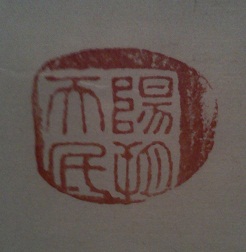
Homemade chop: 阳朔天民
Xu was interesting because he was a master of the classical style of Chinese painting, but was also one of the first Chinese to master Western oil painting, and use it to portray scenes from Chinese legends. 

One thing that stuck out for me when checking out his exhibit was all the different seals, or chops, that he made and used on his works. Chops are usually made from carved stone or horn, and often serve as a sort of signature to a painting. But in addition to his chops with his name on them, he also made chops that are kind of whimsical and seem to reflect how he was feeling at the time.

It seemed like some paintings even required their own seal to be made. For instance, when he was living in Yangshuo, (which we visited last year), he painted a lot of mountain and river scenes. (See above: Spring Rain on the Li River)

The seal (above left) for many of those paintings says: "Resident of Yangshuo, Heaven," (阳朔天民 Yáng​shuò​ tiān​ mín), or as the translation in the museum said: "Such good fortune allows me to be a resident of Yangshuo."  If you have ever been to Yangshuo, you know what he means. It is a beautiful place filled with rivers and amazing karst mountains that jut up out of the earth. 

Another seal says: "Destitute hero from the south" (江南贫侠, jiāng​ nán​ pín ​xiá), apparently a reference to his fondness for martial arts. 

Yet another of his chops says "Pavilion of No Maple" (无枫亭 wú fēng tíng). The story behind this is that when Xu worked as a professor at Nanjing University in the 1930s, a hot female student "planted a maple tree in his courtyard," which may or may not be a euphemism for something. In any case, his wife at the time, Jiang Biwei, (蒋碧微, Jiǎng​ Bì​ Wēi​) totally freaked and ripped the tree out of the ground with her bare hands in a jealous berserker rage.

Xu was bummed about the tree, so he carved a seal to commemorate the lost maple. I may have embellished the story a little, but in her memoir, "Beihong and Me," Jiang does say that Xu had a  little "师生恋" (shī​ shēng​ liàn), or teacher-student affair when he was at Nanjing U! 

After he divorced Jiang in 1945, Xu dedicated most of his paintings (and many of the ones at the DAM) to his second wife, Liao Jingwen (廖静文 Liào Jìng​ Wén). He would include a line on the side of the piece that said: "For my beloved wife, Jingwen, to keep." (静文爱妻存 Jìng​ Wén​ ài qī​ cún) Okay, all together now: Awww

I thought the DAM put on a nice show of his works. Seventy years after it was originally supposed to happen, Xu made an impressive first foray into the American art scene.

Saturday, February 4, 2012

V26, Yeah!

[Due to popular demand, here is the story of my most successful foray into acting while in China. The following took place in like 1998.]

“They want a foreigner,” she said. “A fat one.”
Standing in her apartment on the north side of the Fourth Ring Road in Beijing, Chloe Wan was saying she wanted me to help out a friend of hers. The friend’s boyfriend was a director, mainly for TV commercials. He was working on an ad for a product called V26, the “American Diet Shake.” And since many Chinese marketing executives believe that using a foreigner in their commercial will convince people that their product is “international” and “world recognized,” he wanted foreigners.
He needed a fat white person to be in the ad. At first I was offended. “No way,” I said. But strange opportunities are not to be dismissed lightly. I had learned that when somebody offers you an outrageous proposition, you can usually learn from the experience, meet interesting people, or get paid. So I agreed to do it. They would pay me 500 kuai (about 60 bucks at the time), and all I had to do was jump around for a few minutes. Plus I would be on TV. I had been in an ad before, back in 1992. That ad was for Ya Di Jiu, a brand of baijiu, which is a strong, clear, flammable alcoholic beverage. My part was to yell: “Made from pure grains, doesn’t go to your head!” in Chinese and then drain the small cup, which was really filled with Sprite. But I had never seen the ad on TV, and this was a chance to actually see myself in a commercial.
 I arrived at the “studio,” which was actually a birth control education center that had been rented out to the advertising company to do filming in. I took in the scene. The area was a large auditorium, with cameras and lights everywhere. It appeared that several different scenes were being filmed at once. I greeted Chloe and the director, who explained his vision for the ad. My part of the V26 ad involved a really fat guy, a medium fat guy (me), and a skinny guy, to show the transformation from fat slob to slim stud, effected by drinking V26. The three of us were to jump separately in front of a blue screen, and in the end a gigantic cup of V26 would be superimposed in the frame. In the final version, it would look like two fat guys were jumping into a tall, cool tumbler of V26, and a skinny guy was jumping out the other side. But the really fat guy was Chinese, I am a white American, and the skinny end product was a white Belgian. So by drinking V26 not only are you transformed from fat to skinny, but also from one race to another. Amazing stuff.
I was led off to the makeup chamber. Perhaps this was a family planning counselor’s office? Several layers of goop were applied to my face, as well as lipstick. This was the second time I had had makeup applied. The first time had been ten or twelve years previous when I was in Bye-Bye Birdie in Middle School. Who could have guessed that my acting career would take me from phone-waving teen in Bye-Bye Birdie to playing the “before” guy in a Chinese ad for a diet shake?
I went back out to the main floor, and the costumes person gave me a skimpy, white stretchy piece of fabric and told me to change and get ready. I looked at it as if it were a noodle that was dropped on the floor and put back on my plate. It didn’t look big enough to cover one of my legs.
“I can’t wear this,” I said.
Mei guanxi,” the director grinned, using the highly versatile Chinese phrase meaning basically: “It doesn’t matter.” The phrase can be used in a variety of situations, where the implied meaning ranges from “you’re welcome” to “don’t worry about the fact that I just ran over your bicycle with my car, you can get it fixed.” In this case it meant: “Don’t worry if you look like an idiot.”
I slinked off to the dressing room to put on the outfit. Closing the door behind me, I tried to will some sort of disaster upon the studio so I wouldn’t have to go back out in the skin-tight outfit. I wrestled with the garment for a few minutes and eventually slid it up over my legs and torso. It was sort of like a weightlifter’s outfit, with short legs and no sleeves. I spent several minutes trying to suck in my gut and look natural.  
Coming out of the dressing room, I was relieved that no one paid much attention to me. I looked around at the various parts of the commercial that were being filmed. In one section, about a dozen young Chinese in a disco setting were dancing around to implied music, obviously enjoying their slimness. Behind a desk was a middle-aged businesswoman: slim, successful, and nursing a cup of V26. A pair of lovers; a family; and two friends walking along talking about how great it was to drink V26 were also part of the show. Except for the disco dancers, all of the actors were non-Chinese.
Meanwhile the stage was being set for our big jumps. A giant piece of blue cloth was draped against the wall and part of the floor. This was the blue screen which made it possible to digitally insert the giant cup later on. The really fat Chinese guy had done his jump earlier and so was just standing around in street clothes chatting with people. He seemed to be totally comfortable with the idea that he was totally fat. I chatted idly with the Belgian and he mentioned that he worked for a real estate firm. He had also been lured there by a friend, but he had been waiting all day for just one jump. Finally the director told me it was my turn. He said to jump as far and high as I could. When he said go, I sprang with all of my might into the middle of the blue cloth. I did two takes, and it was over. I wanted to go put my regular clothes back on immediately, but he said to wait. However, I did get a black tank top to put on over the white thing.
As I watched the Belgian do his jump, the director said he had an idea for another scene with me in it. This would be as a healthy, strong boy, not a fat boy, he assured me. The scene was me, shot from mid-torso up, and I had to take a big sip of the strawberry version of V26, look into the camera, flex a bicep and said “Yeah!”
This was the part that finally made it into the ad that appeared on TV all across China. The shot was just me and my arm and lasted less than one second, but some people recognized me from the ad. I had people coming up to me saying: “Hey, was that you in the V26 ad?”  All I had to say in response was “Yeah!” and flex a little and they knew it was me.
I was happy not to be shown as a fat person in transition to thin, but rather as a healthy American boy enjoying his shake. The fat Chinese guy and the skinny Belgian eventually showed up in one version of the ad, but the flying middleman in the white leotard was never seen.

Wednesday, December 21, 2011

Good Mourning! The Professional Mourner, or Ku Sang Ren

Recent video footage of North Korean citizens weeping uncontrollably in the frigid streets of Pyongyang got me thinking: Are these people really brainwashed enough to care that the star of Team America: World Police is dead? Or did someone put them up to it?

Answer: Who knows? But, there is an ancient practice that originated in China, (therefore it probably spread to North Korea) of hiring people to mourn at funerals, since it looks better if tons of people are going to miss you after you kick it.

The word for this in Chinese is 哭丧人 (kū​ sāng rén), literally "a person (人) that cries (哭) and mourns (.)"

In case you were wondering, the late dictator Kim Jong-Il's Chinese name is 金正日 (JīnZhèngrì, literally "Proper Sun"), and his son, the young, pudgy prodigy Kim Jong-Eun, who has been named Supreme Leader (or as his friends call him, the "Royale with Cheese") is 恩 (JīnZhèng​'ēn, literally "Proper Kindness".)

"Kim" is one of the most common Korean names (like my stuffed toy raccoon, Mr. Kim, who was made in Korea), and along with Park and Lee they account for almost half of Korean surnames (if you believe Wikipedia).

I digress, as usual. According to my research, in parts of China, namely Sichuan Province, some enterprising unemployed people are digging up this moldy tradition of professional mourning and making a killing as tears-for-hire.

One of these geniuses is 52-year-old Hu Xinglian,(胡 兴莲 Hú​ Xīng​lián), known by her stage name, Jingle Cat Dragonfly. If that sounds weird, it is.

She goes by "Dingding Mao" (叮叮猫 dīng​ dīng ​māo), which means Jingle Cat, but in the Chongqing dialect, that means "dragonfly" (qīngtíng).

Apparently the practice of paying for mourners began in the time of Emperor Wu of the Han Dynasty (汉武帝 Hàn​ Wǔ​dì)​  (141-87 BC). During the Cultural Revolution it was seen as part of the "poisonous influence of Feudalism," (封建流毒 fēng​jiàn ​liú​dú) and was suppressed. After China's reform and opening up, (放, gǎi kāi fàng) in the late 1970s, the practice came back to life, and people like Hu have started to cash in on it.
 
The article I read describes a typical funereal gig for Hu. After finding out a little about the deceased, Hu reads the eulogy with a sad voice, and calls out the person's name between sobs. She may also call out "Mother!" or "Father!" in order to move the crowd. Which is odd since she is not related to the dead person. Sometimes she will kneel before the casket, or even crawl on the floor, wailing after the person's soul, begging it not to leave so soon (see picture). 
 
She makes between 200-800 yuan per session ($25-$100), and in the seven years she has been doing this for a living, she's served about 4,000 people. Although, she said does not actually cry at the funerals, she just fakes it. (If you replace "cry" and " funeral" with other words, this paragraph could be talking about another "ancient profession!") 

It is unclear if she was hired as a consultant for Kim Jong-Il's Million Man Funeral, but the tradition apparently lives on in North Korea. However those mourners probably did not get paid, unless you consider not being executed a form of currency.
 
But it's not all doom and gloom for a professional mourner! Hu is also in a band and they play at weddings, too.

Friday, September 23, 2011

Chinese demons, monsters and other beings

The Qilin. Its appearance is said
to herald the arrival of a great sage.
Welcome to Hell, human.

Here you will find a comprehensive list of demons, devils and assorted supernatural nasties - as they are known to the Chinese. This way, when you are blasted into the abyss by an evil sorcerer, you will have the names of your tormentors at your disposal! (As long as you have wi-fi access and remember to follow this blog.)

Read on, but first, as the saying goes: "报上名来, 免做无名之鬼!" (bào shàng míng lái, miǎn zuò wú míng zhī guǐ, "Tell me your name, so you will not be a nameless ghost! [after you are slain]")

Some of the creatures below are mentioned in the various "Novels of the Weird," (志怪小说 zhì guài xiǎo shuō), that gained popularity in the period of theWei, Jin, and Southern and Northern Dynasties (魏晋南北朝 wèi jìn nán běi cháo), roughly between 220-589 C.E.

During this time, Buddhism was becoming popular (having been introduced in the first century C.E.), Daoism was burgeoning, and Daoist and Confucian ideas were combined into a kind of metaphysical study known as 玄学 (xuán xué, literally "study of the mysterious"). Persian and Greek influences were also seeping into China, so the whole place was awash in myths, legends, superstition, religion and all things mystical and magical.

Other monsters are from the ancient text, the Shan Hai Jing (山海经 shān hǎi jīng), or "Classic of the Mountains and Seas." The author and date of this book are not known, but it is thought to be at least two thousand years old. It is more of a geography book than a list of creatures; it describes known and unknown areas of "China" (such as it was back then) and the inhabitants of those areas, some of whom are monsters.

Additional beings are described in the 4th-century tome, "In Search of Spirits" (搜神记 sōu shén jì) by Eastern Jin Dynasty Court Historian Gan Bao (干宝 gān bǎo). "In Search of Spirits"(or "Records of the Search for the Supernatural") is a compilation of stories and accounts of otherworldly creatures and encounters.

Behold! The Encyclopaedia Obscura de Daemona et Anima Orientalis!
(Apologies to anyone who actually knows Latin and/or Greek.)

- jīng - general term for spirit, or sprite. Also 精灵 jīng líng.

- guǐ - ghost. This is an important character in supernatural lore. It is part of a lot of other characters that have to do with ghasts, ghouls and ghosts, usually found on the left side of the character, e.g. 魑, 魃.

地狱 - dìyù - Hell. Lit. earth/underground prison. There are Buddhist, Daoist, and other interpretations of Hell, but most agree it is not a fun place to spend an afternoon.

- yāo - female demon. Also means "full-figured woman," which was apparently so rare back in ancient times that if you saw one she must be a demon. Common usage is 妖怪 (yāo guài), demon or ghost.

(also written ) - yù - Yu, a turtle-like creature that lurks in dark waters and attacks people by spitting sand at them. Sounds pretty annoying.

幽灵 - yōu líng - ghost, apparition. Literally "dark soul."

狐狸精 - húli jīng - fox spirit. These are typically attractive, female spirits who can assume human form and are generally associated with mischief. They can do magic and live for hundreds or thousands of years. Also used today as an insulting term for a man-stealing homewrecker.

蓝精灵 - lán jīng líng - Smurf. Okay, it's not a Chinese demon, but in Chinese it is literally, "blue spirit."


The legendary Nine-tailed Fox.
九尾狐 - jiǔ wěi hú - Nine-tailed fox. A magical creature that lives in the Qing Qiu Mountains. It "sounds like an infant and can eat people." (according to the Shan Hai Jing). Not to be confused with the "Cat-o-nine-tails."

魑魅 - chī mèi - Chimei, a malevolent demon that lives in the mountains. Don't make it angry.

恶魔 - è mó- demon. Fairly generic word for your basic run-of-the-mill evil demon or devil. Another similar word for demon is 恶煞 (è shà). The first part of both words is (è), which basically means "evil." Evil is made up of two parts: yà - (ugly) and xīn (heart).

- xiāo - Xiao, a one-footed mountain-dwelling fiend. It has one foot, a big head and a small body and attacks people at night. What a jerk.

The Kui
- Kuí - Kui. A one-legged demon of Chinese mythology. Not to be confused with the Xiao, but who knows how to tell the difference?

- bá - Ba, a powerful demigod that can cause droughts. Also known as "Han Ba," 旱魃 (hàn bá). (旱 hàn means drought). Not clear if it is a demon or an actual god.

无支祁 - wú zhī qí - Wu Zhiqi, an ape-like water demon. He is as strong as nine elephants, with a white head and green body. However, he is not much of a threat today since he was defeated and chained up by the legendary Yu the Great (大禹 Dà Yǔ), who lived in the 21st century BCE. Yu the Great is best known for Taming the Great Flood (but he was possibly just an irrigation specialist.)


Sun Wukong, the mischevious Monkey King
孙悟空 - Sūn Wùkōng - Sun Wukong, the Monkey King, the Great Sage, Equal to Heaven. Another famous monkey, Sun Wukong is the magical character from the Classic Novel "Journey to the West" (西遊記 - Xīyóujì). This book also features tons of demons and creatures, and really deserves its own post at some point. Sun Wukong was recruited to help the Tang Dynasty monk Xuan Zang (玄奘 Xuán Zàng) on his pilgrimage to India to retrieve Buddhist scriptures.


- jiān - Jian, a mythical bird with only one eye and one wing, so that only a pair of them can fly (often used in phrases to describe people who are in love and inseparable, eg: 鲽鹣 diéjiān - "a flounder and a Jian-bird," meaning a harmonious and affectionate couple. Um, okay.)

僵尸 - jiāng shī - zombie. Along with the noodle, gunpowder and the dumpling, China also claims it invented the zombie. According to Daoist lore, zombies are dead people whose "limbs are stiff, heads do not lower, eyes do not slant, legs do not separate, and the corpse does not rot." One account says the Yellow Emperor's daughter was cursed by the emperor's legendary rival Chi You, (蚩尤 Chī Yóu) and became a zombie.

Bai Ze

白泽 - baí zé - Bai Ze, a legendary beast-god. The Bai Ze resides in the Kunlun Mountains. Its entire body is white and it can speak human languages. It knows the name and appearance of every type of demon, monster and ghost in existence - and more importantly it knows how to defeat each one. He told this information to the Yellow Emperor (黃帝 Huángdì) in the 26th century BCE, who wrote them down in a book called the "Book of Bai Ze" (白泽图 bái zé tú). This book was lost long ago, but when it existed, it allegedly served as a kind of Field Guide to Monsters, (eat your heart out Gary Gygax) and people would carry it around so they could identify and fend off any supernatural foes they happened to run into.

貔貅 - pí xiū - Pixiu, a mythical hybrid creature that brings luck and wards off evil, having a dragon's head and a lion's body, often with hoofs, wings and tail, and covered in grey fur. It is an angry beast, due in large part to the fact that it has no anus. Doh! It can consume only money, but can't crap it out, so it is lucky to have one in your house. Or, at least a statue of one. If you come by a Pixiu statue, you should put a coin in its mouth and leave it there, for good luck. It will attract money from all over the place to eat. It is said to be one of the nine offspring of the dragon. It looks a lot like a Qilin, but only has one horn in the middle of its head.

麒麟 - qí lín - Qilin. (Same as Kirin, in Japanese, like the beer.) This sagatious chimera is mostly good, but will punish the wicked. It's depiction has varied over the centuries, but it generally has a dragon head with two horns, hooves, lion eyes, tiger back, bear waist, and snake scales. It is the steed of the gods and can fly. One theory is that it was an early name for a giraffe, probably before anyone had actually seen one, although admittedly giraffes are insane looking.

獬豸 - xiè zhì - Xiezhi. A guardian beast-god similar to the Qilin, but with black fur, and only one horn. It can speak human languages and is able to sense good and evil. It will seek out corrupt government officials, after which it impales them with its horn and eats them. Must be extinct.

女娲 - Nǚwā - Nu Wa, not really a beast, but the creator of humanity. A strange serpent-bodied woman, associated with Fuxi (伏羲 fúxī) the male half of the creator of humanity who may or may not be Nu Wa's brother. No wonder the world is so screwed up.

鷫鸘 - sù shuāng - Su Shuang. One of the god-birds of the Five Directions, the Su Shuang resides in the West. It has a long neck, is green and resembles a wild goose, but it can turn its feathers to fur.

魍魉 - wǎngliǎng - A fairy monster that lives in mountains and streams.

- péng – Peng bird. A huge mythical bird, similar to the Roc. Sometimes used in people's names so you think they are a badass.

Wow. As I research these things, more and more seem to crop up. That is it for now. Please comment if you can think of any more I should include. Thanks for reading!

Tuesday, June 7, 2011

Chomping Thru China: Where to eat in Beijing

Welcome to Chomping Thru China, (中国食记, Zhōng​guó​ shí​ jì) a three-part travelogue about where to eat in different cities in China! This is not a comprehensive guide, it is more just a bunch of places we ate at and liked on our recent visit to China. Get ready for some major taste-bud envy. First up: Beijing!

Black Sesame Kitchen
3 Black Sesame Hutong,
Dongcheng District, Beijing, China 100009

After a full day of going through three boxes of my crap at my friend Rao Shan's parents' house that had been there gathering dust for the last decade, we set out for my Journalism School classmate, Jen Lin-Liu's restaurant/cooking school in the heart of Beijing's old city.

Black Sesame Kitchen (黑芝麻厨房 hēi​zhī​ma​ chú​fáng) is not easy to find, but it is worth the search. The restaurant is in the back of a renovated courtyard in one of Beijing's dwindling historic alleyways. I found this fascinating, because when I left in 1999, a foreigner operating a business in an old hutong would have been difficult to pull off at best, if not impossible (as far as I know). Jen's place turned out to be the first of three surprisingly delightful culinary and brewtastic finds that we came across in the alleyways.

Beijing is famous for its ancient alleys, known as "hutongs," (胡同, hútòng)​. The hutongs date from the Yuan Dynasty (1271-1368) and some have cool, whimsical names like Silver Bowl hutong, Chicken Claw hutong, and Big Tea Leaf hutong (where I lived for a little while). Jen's place was in - where else? Black Sesame hutong (黑芝麻胡同 hēi​zhī​ma​ hú​tòng), No. 3 to be exact.

You have to contact BSK ahead of time to make a reservation either for dinner or actual cooking classes. In true last-minute style (and encouraged by my mom), I emailed Jen from the airport in San Francisco a few hours before we left for Beijing to see if she was around. She was nice enough to set us up with a special reservation on short notice and she signed us up for the awesome 10-course dinner complete with wine and the ever-popular Yanjing beer (燕京啤酒 Yān​jīng pí​jiǔ). The food was prepared in sight by Jen's former cooking teachers, and it was a sampling of some traditional favorites as well as some more creative options. Here is a quick look at what we had:

- Pork and pumpkin potstickers (猪肉南瓜锅贴 zhū​ròu nán​guā guō​tiē)
- Fried shiitake mushrooms with coriander and carrots (素炒膳丝 sù​ chǎo​ shàn​ sī)
- Flash fried lamb with leeks (葱爆羊肉 cōng bào​ yáng​ròu)
- Red-braised eggplant (红烧茄子 hóng​ shāo ​qié​zi)
- Wok fried string beans (干炒豆角 gān chǎo​ dòu​jiǎo)
- Red-braised pork belly (红烧肉 hóng​ shāo ​ròu)
- Garlic broccoli with goji berries (蒜蓉西兰花 suàn​ róng​ xī​lán​huā)
- Cashew kung-pao chicken (宫保鸡丁 gōng​bǎo​ jī​dīng)
- Pine nut beef stir fry (松仁牛肉 sōng​rén​ niú​ròu)
- And for dessert: Candied sweet potato with sweet cream (拔丝红薯 bá​sī​ hóng​shǔ)

If you just said "holy crap" (我靠 wǒ​kào) in your head you are well-justified. It was a ton of food for the four of us but we devoured most of it. My favorite were the potstickers. I love those anyway, but the pumpkin gave the filling a delectable creaminess that was a nice twist on the normal version. The crispy fried shiitakes with coriander were also outstanding, I thought.

The sweet potatoes were coated in hot liquid caramel, so you grab a piece with your chopsticks and dunk it in the ice cream to cool it off. This creates long strands of caramel as you pull it off the plate (which is why the dish is called 拔丝, bá​ sī: "pulling threads") and then it makes a shell of solidified sugar as the cream cools it off. Really yummy. I'd be remiss if I didn't also plug Jen's book, "Serve the People: A stir-fried journey through China," which is a great memoir of her time learning to cook all over the country (complete with recipes). The fact that she was in town when we were was pure serendipity, since she was back only briefly before returning to the Silk Road gathering material for another book.

Shunfeng 123
Worker's Stadium, West Gate
Chaoyang District, Beijing

My friend Rao, whose parents were keeping my stuff, organized a mini-reunion of some of our classmates from the no-longer-existent Foreign Language Normal College (外语师范学院, wài​yǔ shī​fàn ​xué​yuàn) where I first went to China for a semester abroad in 1992. It was fun to see these guys, some of who were dorky romantics back in the day, now all grown up and organized with wives and jobs. But they still had a taste for fun and hanging out drinking the local Beijing swill, Er Guo Tou (二锅头 èrguōtóu), a 112-proof liquor loved by all for its extremely favorable cost-to-inebriation ratio.

I remembered that when I first met these guys, we were instructed by the school leaders not to discuss politics of any kind, and we were not to be seen walking around on the street with them (presumably to keep them from getting in trouble). Now of course, we can talk about anything and they can feel confident hanging out with morally bankrupt foreigners such as myself.

Rao set us up with a huge table at a restaurant that he is actually part owner of, called Shun Feng 123 (顺风 123, shùn​fēng yī èr sān). This place is well-known for its Sichuan cuisine, and is an upscale joint just inside the western entrance to the Worker's Stadium (工人体育场 gōng​rén​ tǐ​yù​chǎng).

I did not keep track of all the dishes we had here, but I remember everything I had was really good. We were too busy reminiscing and drinking Er Guo Tou and making fun of each other. I do remember a spicy frog dish (I let that slide by on the lazy susan), and of course Ma Po Tofu, (麻婆豆腐 má​pó​ dòu​fǔ) a classic Sichuan favorite. One feature of Sichuan dishes is the presence of a spice called Sichuan peppercorn, or sometimes prickly ash (花椒 huā​jiāo). It is a strange spice that basically makes your tongue and mouth numb. An acquired taste, but very unique and not to be missed.

After ShunFeng 123, a few of us headed to a bar, Frank's Place, nearby. This place was interesting in that it showed the international side of Beijing, where you could - almost - be anywhere in the world. We ordered Guinness, french fries, and chatted over heavy wooden pub tables. There were a few touches that let you know you were not in College Town, USA. First, you could smoke inside. Second, while the Guinness was a respectable 8-9 bucks, a bottle of Pabst Blue Ribbon cost a mind-boggling $91 - that's US dollars mind you. We tried to figure out what the deal was, but no one had a good explanation. Someone should find out who PBR's marketing director for Asia is and hire them to do pretty much anything. Admittedly, it is not your average PBR tall-boy. It's called "Pabst Blue Ribbon 1844" and is a special brew only sold in China which comes in a fancy bottle. Still. It's PBR. Come on, China.


Great Leap Brewery and Hutong Pizza
Brewery: 6 Doujiao Hutong
Dongcheng District, Beijing
Pizza: 9 Yinding Qiao Hutong,
Dongcheng District, Beijing

While at the Black Sesame Kitchen, we were alerted to the presence of a real novelty, a Beijing microbrewery. After a morning at the Summer Palace, (颐和园, yí​hé​yuán), where my friend Mark and I procured awesome panda hats (see photo), we high-tailed it back to Dongcheng District to find the place: Great Leap Brewery. This was another hutong gem, located in Doujiao (Bean) Hutong (豆角胡同, dòu​jiǎo hútòng), in a courtyard behind a large steel door, engraved with the words "Great Leap Beer" (大跃啤酒 dà​yuè pí​jiǔ). While the name seemed kind of distasteful, the beer was quite the opposite. The name undoubtedly refers to the "Great Leap Forward," (大跃进 dà ​yuè ​jìn), a political movement in China from 1958-1960 in which an estimated 30 million people starved to death. Mao had decided that drastic steps were needed to propel China into a full-blown Communist powerhouse, so he made everyone melt their metal items to produce "steel" in furnaces that burned everything people could get their hands on including their front doors. Meanwhile, idiotic agricultural techniques were enforced and tons of crops failed or were left to rot. ANYWAY, who knows what the owner was thinking, but like I said the beer was good.


The most distinctive was the Honey Ma Gold, which used the aforementioned Prickly Ash spice to create a little tingle in the aftertaste. They also had a decent porter and the IPA was tasty as well. We had to ask directions to the place, and the guy who led us to it was a local, but had never been in there. One of the staff (an American girl) said locals come by and check it out but don't really get the concept of a microbrewery.

"They either come by and bum a cigarette and leave, or else ask for the strongest, most expensive beer we have," she said.

While we were there, the hostess recommended "Hutong Pizza" (胡同比萨 hú​tòng​ bǐ​sà) for a food choice. We got veggie and meat 'zas, both of which were pretty good. They sure went well with the beers. Crust was a little dry, but overall it was enjoyable, and it was delivered to the brewery, which was key for hungry pandas.

Xian'r Lao Man
252 Andingmen Nei Dajie
Dongcheng District, Beijing


"Not to be missed" is all I can say about this place. Just a few blocks away from the Buddhist Lama Temple (雍和宫 Yōng​hé​ Gōng), Xian'r Lao Man (馅老满 xiàn'r​ lǎo mǎn) is a well-known dumpling restaurant, with dozens of types of dumpling fillings to choose from. The first part of the place's name, Xiàn'r (馅) means filling. It is actually "xian" but since you are in Beijing you have to add the "er" at the end to be authentic in your accent. Being able to read (and speak) Chinese here is a must, otherwise you are stuck looking at the picture-menu, which does not help with the dumplings and only minimally with the other dishes.

You can order a minimum of 10 of each type of dumpling (饺子 jiǎo​zi), and you can either have them steamed or fried. We ordered fillings of egg and chives (鸡蛋韭菜 jī​dàn jiǔ​cài), beef and fennel (牛肉茴香 niú​ròu​ huí​xiāng), the Xianr Lao Man special filling (probably pork, egg, cabbage, shrimp and something), and cilantro and pork (香菜猪肉 xiāng​cài zhū​ròu) (if memory serves). Not only are the dumplings delicious here, the other food is terrific too. But don't just take my word for it (<--links to fun foodie blog Beijing Haochi). We also ordered a plate of kung pao chicken and a bunch of other stuff including the yummy cold-dressed dried tofu strips (凉拌腐竹 liáng​bàn​ fǔ​zhú). Oh and the Beijing favorite, Noodles in Fermented Soy Bean Paste (炸酱面 zhà​jiàng​miàn). So good. We also had a fiesty, cute waitress who served us up with a healthy portion of studied indifference. I was barked at when I asked her for an extra bowl.

That about wraps it up for Beijing. Stay tuned for the next installment, Chomping Thru China: Shanghai!

If you have any other thoughts about favorite restaurants, post them below, and thanks for reading!

Saturday, April 30, 2011

Scroll deciphered (mostly)


For our wedding, we received a beautiful antique-looking scroll (right) from a good family friend. The scroll is on yellowed paper, and shows a condor (eagle? vulture?) sitting on a tree branch and looking to the side with some calligraphy on the right side. There was not too much information about it, and we finally hung it up in the stairwell so I decided to do some research.

I could make out most of the first line of the poem, so I went and googled it. Turns out the poem was written by a Yuan Dynasty poet, Chen Ruzhi (陈汝秩 Chén Rúzhì), who died in 1385. There is little information on this guy besides that he was a poet and calligrapher and painter. His brother, Chen Ruyan (陈汝言, Chén Rúyán​) may have been more successful since there is one of his landscape paintings in the Cleveland Museum of Art. All of the cool Chinese kids get their paintings in there after all. After some Googlage, I found out the poem says:

晚风吹雨过林庐
柿叶飘红手自书
无限潇潇江海意
一樽相对忆鲈鱼


(wǎn fēng chuī yǔ guò lín lú
shì yè piāo hóng shǒu zì shū
wú xiàn xiāo xiāo jiāng hǎi yì
yī zūn xiāng duì yì lú yú)

I am probably missing a lot of nuances here, but for what its worth, my translation is:

"The evening wind blows rain through the forest hut
Persimmon leaves blow red as my hand writes calligraphy
The limitless sounds convey the meanings of the rivers and seas
A jug of wine to face recollections of perch."

Ruzhi lived at the end of the Yuan and beginning of the Ming dynasties, in the 14th century. I can only wonder if "recollections of perch" is some kind of pun or political allegory, because otherwise it is slightly strange. Of course in the grand tradition of writing poetry, he was most likely hammered (hence the "jug of wine"). Personally I like the line, because I do have fond memories of fishing with my brothers and dad at Lake Champlain and catching perch - and pickerel and pike.

It is not clear when he wrote the poem, but his brother Ruyan was killed by imperial forces at the beginning of the Ming Dynasty after having served with the famous rebel leader Zhang Shicheng (张士诚 Zhāng Shìchéng). Zhang rose up against the Mongols of the Yuan, but was not successful enough to start his own dynasty and was defeated by the dude (Zhu Yuanzhang 朱元璋 Zhū​ Yuán​zhāng) who ultimately started the Ming Dynasty in 1368.​ So perhaps the perch reference has something to do with that. Unknown.

ANYWAY, that is not to suggest that this scroll was painted or written in the 1300s, but the poem is from then. There is a name at the end of the poem, but I can't read it so I don't have a good way to find out much more.... for now. Stay tuned! Or if you have an idea let me know. Here is a closeup, the 2 characters above the red seals. Maybe it is a year designation?

UPDATE: I believe the first character is (kuí) meaning sunflower, also a rare surname. According to Baidu, people with the Chinese surname Kui account for 0.005% of the population, or about 60,000 people, mostly in Henan Province. That narrows it down a little!

葵 is also "Aoi," a Japanese name. Hmm.

ANOTHER UPDATE: OK, I think I got it, although it does not answer the real question of who painted this and when. I think the characters say Kuitang (葵塘 kuítáng), which is a small town in either Guangdong Province, or there is also one in Guangxi Autonomous Region, could be either one.