Tuesday, June 7, 2011

Chomping Thru China: Where to eat in Beijing

Welcome to Chomping Thru China, (中国食记, Zhōng​guó​ shí​ jì) a three-part travelogue about where to eat in different cities in China! This is not a comprehensive guide, it is more just a bunch of places we ate at and liked on our recent visit to China. Get ready for some major taste-bud envy. First up: Beijing!

Black Sesame Kitchen
3 Black Sesame Hutong,
Dongcheng District, Beijing, China 100009

After a full day of going through three boxes of my crap at my friend Rao Shan's parents' house that had been there gathering dust for the last decade, we set out for my Journalism School classmate, Jen Lin-Liu's restaurant/cooking school in the heart of Beijing's old city.

Black Sesame Kitchen (黑芝麻厨房 hēi​zhī​ma​ chú​fáng) is not easy to find, but it is worth the search. The restaurant is in the back of a renovated courtyard in one of Beijing's dwindling historic alleyways. I found this fascinating, because when I left in 1999, a foreigner operating a business in an old hutong would have been difficult to pull off at best, if not impossible (as far as I know). Jen's place turned out to be the first of three surprisingly delightful culinary and brewtastic finds that we came across in the alleyways.

Beijing is famous for its ancient alleys, known as "hutongs," (胡同, hútòng)​. The hutongs date from the Yuan Dynasty (1271-1368) and some have cool, whimsical names like Silver Bowl hutong, Chicken Claw hutong, and Big Tea Leaf hutong (where I lived for a little while). Jen's place was in - where else? Black Sesame hutong (黑芝麻胡同 hēi​zhī​ma​ hú​tòng), No. 3 to be exact.

You have to contact BSK ahead of time to make a reservation either for dinner or actual cooking classes. In true last-minute style (and encouraged by my mom), I emailed Jen from the airport in San Francisco a few hours before we left for Beijing to see if she was around. She was nice enough to set us up with a special reservation on short notice and she signed us up for the awesome 10-course dinner complete with wine and the ever-popular Yanjing beer (燕京啤酒 Yān​jīng pí​jiǔ). The food was prepared in sight by Jen's former cooking teachers, and it was a sampling of some traditional favorites as well as some more creative options. Here is a quick look at what we had:

- Pork and pumpkin potstickers (猪肉南瓜锅贴 zhū​ròu nán​guā guō​tiē)
- Fried shiitake mushrooms with coriander and carrots (素炒膳丝 sù​ chǎo​ shàn​ sī)
- Flash fried lamb with leeks (葱爆羊肉 cōng bào​ yáng​ròu)
- Red-braised eggplant (红烧茄子 hóng​ shāo ​qié​zi)
- Wok fried string beans (干炒豆角 gān chǎo​ dòu​jiǎo)
- Red-braised pork belly (红烧肉 hóng​ shāo ​ròu)
- Garlic broccoli with goji berries (蒜蓉西兰花 suàn​ róng​ xī​lán​huā)
- Cashew kung-pao chicken (宫保鸡丁 gōng​bǎo​ jī​dīng)
- Pine nut beef stir fry (松仁牛肉 sōng​rén​ niú​ròu)
- And for dessert: Candied sweet potato with sweet cream (拔丝红薯 bá​sī​ hóng​shǔ)

If you just said "holy crap" (我靠 wǒ​kào) in your head you are well-justified. It was a ton of food for the four of us but we devoured most of it. My favorite were the potstickers. I love those anyway, but the pumpkin gave the filling a delectable creaminess that was a nice twist on the normal version. The crispy fried shiitakes with coriander were also outstanding, I thought.

The sweet potatoes were coated in hot liquid caramel, so you grab a piece with your chopsticks and dunk it in the ice cream to cool it off. This creates long strands of caramel as you pull it off the plate (which is why the dish is called 拔丝, bá​ sī: "pulling threads") and then it makes a shell of solidified sugar as the cream cools it off. Really yummy. I'd be remiss if I didn't also plug Jen's book, "Serve the People: A stir-fried journey through China," which is a great memoir of her time learning to cook all over the country (complete with recipes). The fact that she was in town when we were was pure serendipity, since she was back only briefly before returning to the Silk Road gathering material for another book.

Shunfeng 123
Worker's Stadium, West Gate
Chaoyang District, Beijing

My friend Rao, whose parents were keeping my stuff, organized a mini-reunion of some of our classmates from the no-longer-existent Foreign Language Normal College (外语师范学院, wài​yǔ shī​fàn ​xué​yuàn) where I first went to China for a semester abroad in 1992. It was fun to see these guys, some of who were dorky romantics back in the day, now all grown up and organized with wives and jobs. But they still had a taste for fun and hanging out drinking the local Beijing swill, Er Guo Tou (二锅头 èrguōtóu), a 112-proof liquor loved by all for its extremely favorable cost-to-inebriation ratio.

I remembered that when I first met these guys, we were instructed by the school leaders not to discuss politics of any kind, and we were not to be seen walking around on the street with them (presumably to keep them from getting in trouble). Now of course, we can talk about anything and they can feel confident hanging out with morally bankrupt foreigners such as myself.

Rao set us up with a huge table at a restaurant that he is actually part owner of, called Shun Feng 123 (顺风 123, shùn​fēng yī èr sān). This place is well-known for its Sichuan cuisine, and is an upscale joint just inside the western entrance to the Worker's Stadium (工人体育场 gōng​rén​ tǐ​yù​chǎng).

I did not keep track of all the dishes we had here, but I remember everything I had was really good. We were too busy reminiscing and drinking Er Guo Tou and making fun of each other. I do remember a spicy frog dish (I let that slide by on the lazy susan), and of course Ma Po Tofu, (麻婆豆腐 má​pó​ dòu​fǔ) a classic Sichuan favorite. One feature of Sichuan dishes is the presence of a spice called Sichuan peppercorn, or sometimes prickly ash (花椒 huā​jiāo). It is a strange spice that basically makes your tongue and mouth numb. An acquired taste, but very unique and not to be missed.

After ShunFeng 123, a few of us headed to a bar, Frank's Place, nearby. This place was interesting in that it showed the international side of Beijing, where you could - almost - be anywhere in the world. We ordered Guinness, french fries, and chatted over heavy wooden pub tables. There were a few touches that let you know you were not in College Town, USA. First, you could smoke inside. Second, while the Guinness was a respectable 8-9 bucks, a bottle of Pabst Blue Ribbon cost a mind-boggling $91 - that's US dollars mind you. We tried to figure out what the deal was, but no one had a good explanation. Someone should find out who PBR's marketing director for Asia is and hire them to do pretty much anything. Admittedly, it is not your average PBR tall-boy. It's called "Pabst Blue Ribbon 1844" and is a special brew only sold in China which comes in a fancy bottle. Still. It's PBR. Come on, China.


Great Leap Brewery and Hutong Pizza
Brewery: 6 Doujiao Hutong
Dongcheng District, Beijing
Pizza: 9 Yinding Qiao Hutong,
Dongcheng District, Beijing

While at the Black Sesame Kitchen, we were alerted to the presence of a real novelty, a Beijing microbrewery. After a morning at the Summer Palace, (颐和园, yí​hé​yuán), where my friend Mark and I procured awesome panda hats (see photo), we high-tailed it back to Dongcheng District to find the place: Great Leap Brewery. This was another hutong gem, located in Doujiao (Bean) Hutong (豆角胡同, dòu​jiǎo hútòng), in a courtyard behind a large steel door, engraved with the words "Great Leap Beer" (大跃啤酒 dà​yuè pí​jiǔ). While the name seemed kind of distasteful, the beer was quite the opposite. The name undoubtedly refers to the "Great Leap Forward," (大跃进 dà ​yuè ​jìn), a political movement in China from 1958-1960 in which an estimated 30 million people starved to death. Mao had decided that drastic steps were needed to propel China into a full-blown Communist powerhouse, so he made everyone melt their metal items to produce "steel" in furnaces that burned everything people could get their hands on including their front doors. Meanwhile, idiotic agricultural techniques were enforced and tons of crops failed or were left to rot. ANYWAY, who knows what the owner was thinking, but like I said the beer was good.


The most distinctive was the Honey Ma Gold, which used the aforementioned Prickly Ash spice to create a little tingle in the aftertaste. They also had a decent porter and the IPA was tasty as well. We had to ask directions to the place, and the guy who led us to it was a local, but had never been in there. One of the staff (an American girl) said locals come by and check it out but don't really get the concept of a microbrewery.

"They either come by and bum a cigarette and leave, or else ask for the strongest, most expensive beer we have," she said.

While we were there, the hostess recommended "Hutong Pizza" (胡同比萨 hú​tòng​ bǐ​sà) for a food choice. We got veggie and meat 'zas, both of which were pretty good. They sure went well with the beers. Crust was a little dry, but overall it was enjoyable, and it was delivered to the brewery, which was key for hungry pandas.

Xian'r Lao Man
252 Andingmen Nei Dajie
Dongcheng District, Beijing


"Not to be missed" is all I can say about this place. Just a few blocks away from the Buddhist Lama Temple (雍和宫 Yōng​hé​ Gōng), Xian'r Lao Man (馅老满 xiàn'r​ lǎo mǎn) is a well-known dumpling restaurant, with dozens of types of dumpling fillings to choose from. The first part of the place's name, Xiàn'r (馅) means filling. It is actually "xian" but since you are in Beijing you have to add the "er" at the end to be authentic in your accent. Being able to read (and speak) Chinese here is a must, otherwise you are stuck looking at the picture-menu, which does not help with the dumplings and only minimally with the other dishes.

You can order a minimum of 10 of each type of dumpling (饺子 jiǎo​zi), and you can either have them steamed or fried. We ordered fillings of egg and chives (鸡蛋韭菜 jī​dàn jiǔ​cài), beef and fennel (牛肉茴香 niú​ròu​ huí​xiāng), the Xianr Lao Man special filling (probably pork, egg, cabbage, shrimp and something), and cilantro and pork (香菜猪肉 xiāng​cài zhū​ròu) (if memory serves). Not only are the dumplings delicious here, the other food is terrific too. But don't just take my word for it (<--links to fun foodie blog Beijing Haochi). We also ordered a plate of kung pao chicken and a bunch of other stuff including the yummy cold-dressed dried tofu strips (凉拌腐竹 liáng​bàn​ fǔ​zhú). Oh and the Beijing favorite, Noodles in Fermented Soy Bean Paste (炸酱面 zhà​jiàng​miàn). So good. We also had a fiesty, cute waitress who served us up with a healthy portion of studied indifference. I was barked at when I asked her for an extra bowl.

That about wraps it up for Beijing. Stay tuned for the next installment, Chomping Thru China: Shanghai!

If you have any other thoughts about favorite restaurants, post them below, and thanks for reading!

Saturday, April 30, 2011

Scroll deciphered (mostly)


For our wedding, we received a beautiful antique-looking scroll (right) from a good family friend. The scroll is on yellowed paper, and shows a condor (eagle? vulture?) sitting on a tree branch and looking to the side with some calligraphy on the right side. There was not too much information about it, and we finally hung it up in the stairwell so I decided to do some research.

I could make out most of the first line of the poem, so I went and googled it. Turns out the poem was written by a Yuan Dynasty poet, Chen Ruzhi (陈汝秩 Chén Rúzhì), who died in 1385. There is little information on this guy besides that he was a poet and calligrapher and painter. His brother, Chen Ruyan (陈汝言, Chén Rúyán​) may have been more successful since there is one of his landscape paintings in the Cleveland Museum of Art. All of the cool Chinese kids get their paintings in there after all. After some Googlage, I found out the poem says:

晚风吹雨过林庐
柿叶飘红手自书
无限潇潇江海意
一樽相对忆鲈鱼


(wǎn fēng chuī yǔ guò lín lú
shì yè piāo hóng shǒu zì shū
wú xiàn xiāo xiāo jiāng hǎi yì
yī zūn xiāng duì yì lú yú)

I am probably missing a lot of nuances here, but for what its worth, my translation is:

"The evening wind blows rain through the forest hut
Persimmon leaves blow red as my hand writes calligraphy
The limitless sounds convey the meanings of the rivers and seas
A jug of wine to face recollections of perch."

Ruzhi lived at the end of the Yuan and beginning of the Ming dynasties, in the 14th century. I can only wonder if "recollections of perch" is some kind of pun or political allegory, because otherwise it is slightly strange. Of course in the grand tradition of writing poetry, he was most likely hammered (hence the "jug of wine"). Personally I like the line, because I do have fond memories of fishing with my brothers and dad at Lake Champlain and catching perch - and pickerel and pike.

It is not clear when he wrote the poem, but his brother Ruyan was killed by imperial forces at the beginning of the Ming Dynasty after having served with the famous rebel leader Zhang Shicheng (张士诚 Zhāng Shìchéng). Zhang rose up against the Mongols of the Yuan, but was not successful enough to start his own dynasty and was defeated by the dude (Zhu Yuanzhang 朱元璋 Zhū​ Yuán​zhāng) who ultimately started the Ming Dynasty in 1368.​ So perhaps the perch reference has something to do with that. Unknown.

ANYWAY, that is not to suggest that this scroll was painted or written in the 1300s, but the poem is from then. There is a name at the end of the poem, but I can't read it so I don't have a good way to find out much more.... for now. Stay tuned! Or if you have an idea let me know. Here is a closeup, the 2 characters above the red seals. Maybe it is a year designation?

UPDATE: I believe the first character is 葵 (kuí) meaning sunflower, also a rare surname. According to Baidu, people with the Chinese surname Kui account for 0.005% of the population, or about 60,000 people, mostly in Henan Province. That narrows it down a little!

葵 is also "Aoi," a Japanese name. Hmm.

ANOTHER UPDATE: OK, I think I got it, although it does not answer the real question of who painted this and when. I think the characters say Kuitang (葵塘 kuítáng), which is a small town in either Guangdong Province, or there is also one in Guangxi Autonomous Region, could be either one.

Wednesday, April 6, 2011

China: At last!


After 12 years, I finally returned to China for a two-week visit! Michala and I met up with our friends Mark and Lisa for an awesome time hitting Beijing, Shanghai, and Xiamen with them before M and I moved on to the small city of Yangshuo (阳朔, Yáng​shuò​) in Guangxi Zhuang autonomous region ​(廣西壯族自治區Guǎng​xī​ Zhuàng​zú ​zì​zhì​qū).


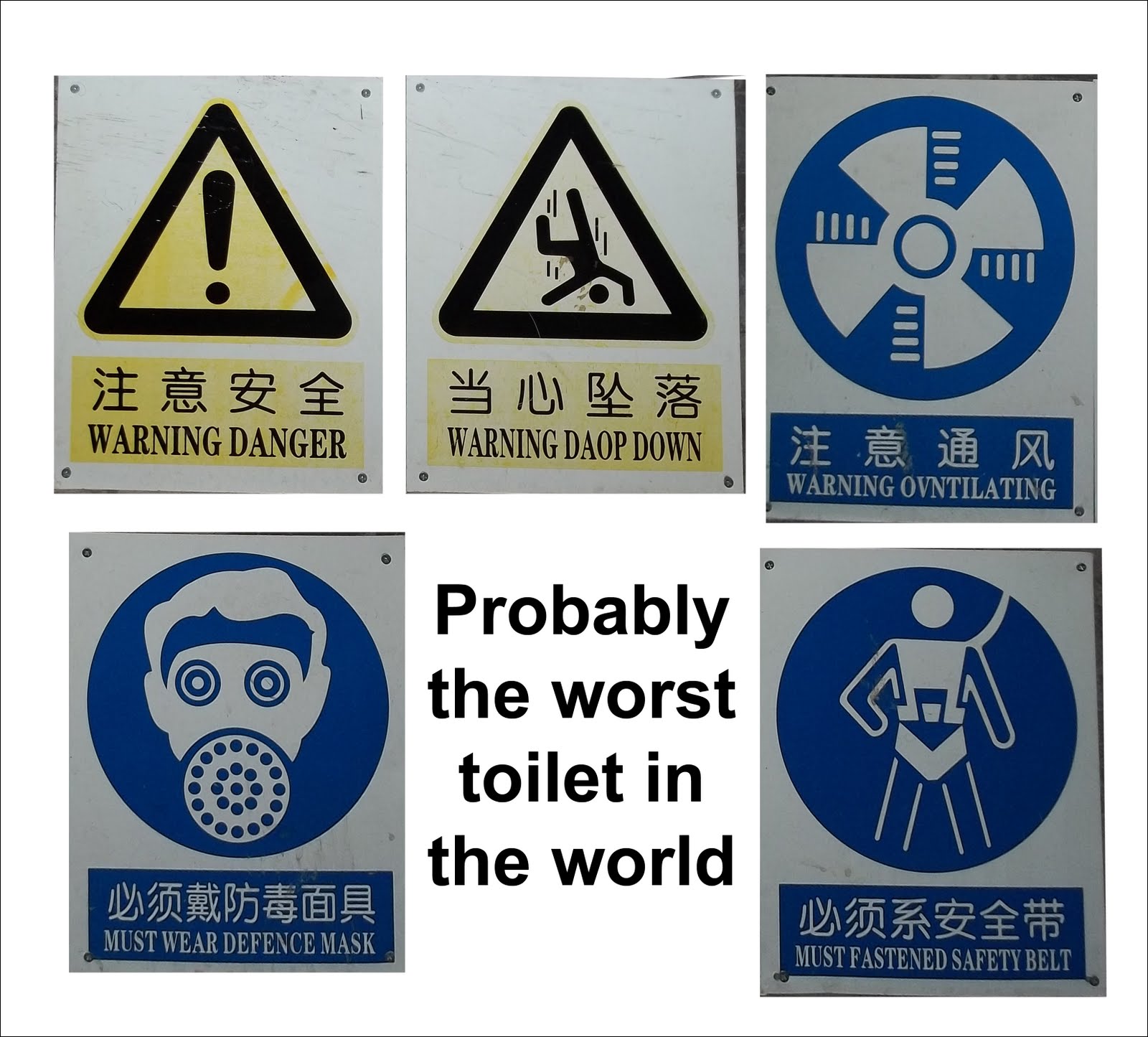
It is hard to sum up in a few sentences the feeling of returning to China after so long, but suffice it to say that it felt like going home, like going for the first time, like digging around in my past, and like opening a window on the future. As always it is place of great contrasts. Take these two photos for example. Above: A detail from the Great Wall (cháng ​chéng, ​长城) at Mutianyu (Mùtiányù, 慕田峪). Majestic, beautiful, full of history and intrigue, a place of solitude and somewhere I could probably go everyday. Then, on the other end of the spectrum - this apocalypse-ready signage, seen on the side of a public bathroom in an alleyway (My caption). Slightly ridiculous, kind of gross, and frankly a bit frightening.


My only guess is that the signs were placed there ahead of the Olympics, in order to discourage foreigners from going in there - without their gas masks and safety harness, which in theory will prevent you from the "Daop down" into the cesspits in case of catastrophic failure of the "Ovntilating" system.


In spite of the bathroom situation, and the eternal search of my comrades for what we called a "Western deucer," we all had a good time. More evidence I had been gone a long time appeared in the form of Beijing traffic. When I left in 1999, there were three ring roads around the city, with a fourth being constructed. Today there are six, with the Sixth Ring Road (六环路, liù huán lù) having a circumference of about 200 km. Apparently a seventh is on the way. The traffic was also terrible. It took forever to get anywhere by taxi and some cabbies even flat out refused to take us certain places during rush hour.


One important thing I did in Beijing was to retrieve my trumpet. I had left a bunch of stuff (3 boxes worth) at my friend's house. Among these boxes of mostly junk was my trumpet, a nice nickel silver horn that I have had since grade school. It is a beauty and it was fun to reunite with it, although I need to get it cleaned.


Shanghai was like an alien spaceport. I had never spent much time there, but it had obviously changed a lot. For one thing the buildings all had ads on them. I don't mean billboards, I mean entire buildings that were 60-100 stories tall lit up and ads and graphics danced across the surface as millions of tiny lights on the sides of the buildings, acting like huge monitors.


I'd never been to Xiamen (厦门, Xià​mén) ​before, and we only stayed there for one full day. The main thing we saw there was Gulangyu (鼓浪屿, Gǔlàngyǔ)​, which was a small island, near the city of Xiamen, which is also an island.


There was a funny scene where I purchased tickets for the "ferry" across to Gulangyu. I paid for the tickets, but received no tickets. The girl came out of the ticket office and led us to a dock where there sat a large Mark-Twain-ish style river boat, which we approached and got ready to board. "No that's the boat that goes around the island," she said.


She led us to the other side of he dock, where there was some kind of tug boat or fishing rig, maybe 30 feet long. We shrugged as the woman indicated we should get on. Not as good as the other boat, but OK, we were all up for the experience. Then she says we should keep going! So we walked across the deck where there was a small 12-foot motor boat with a teenager behind the wheel. "That's your boat," she said. Fortunately the ride was only about 30 seconds long and waters were fairly calm.


After Xiamen, Mark and Lisa rejoined their cruise, and M and I went on to Yangshuo in Guangxi. This is a spectacular place to visit, for the weird, tree covered limestone karst mountains that are everywhere. More on that place later!


In all, it was a great trip. I had sort of assumed that the China chapter of my life was complete, but now I am not so sure. It is still a fascinating country, and the fact that my spoken Mandarin was still in good shape was encouraging. The fact that Michala liked it there and had a good time was also a good sign for future dealings with the place. We also met up with several friends that I had not seen in years, so that was also great to re-activate those relationships.


Mark summed it up nicely, when I was talking about having not been back for so long. He said: "It was time." I owe a special thanks to Mark and Lisa for making the trip actually happen. I guess we'll see what the future brings. Looking forward to more trips to the dynamic, wacky, frustrating and inspiring, ancient and modern country of China, land of contrasts. As I write, things are springing to mind, so hopefully more detailed posts will follow in the not too distant future.

Wednesday, February 9, 2011

Been a long time since I blogged and rolled


Me: Forgive me Blogger, for I have sinned. It has been like four months since my last blog session.

Blog: Infidel! How dare you ignore me? Have two Bloody Marys and say one Our Blogger and you are forgiven. In nomini blogii y googlii y webus sanctii, amen.

OK, now that I got that out of the way, here is my new blog post.

Recently I found out that my friend Dewey Webster is working on the Seattle Chinese Garden. This project is really cool. It is an effort to construct an authentic Chinese garden and courtyards in Seattle.

Of course no Chinese courtyard is without that staple of Occidental entryways: the couplet. Oftentimes on either side of an entryway to a courtyard or other doorway, you will see plaques with vertical lines of writing on them. The couplets are poems that are supposed to say something about the place they are hung at.

Dewey sent me pictures of the various couplets, as well as the overhead plaques that say what area you are entering, and asked if I wanted to take a crack at translating some of them. How could I resist? Not only is it a great reason to update the blog, it is a way to be a part of a cool project. So, here are the couplets.


Note: The plaques are written traditionally, right to left, and top to bottom. For my own intense porpoises, I have converted to regular left to right.


西华园
Xi Hua Yuan
Looks simple enough, right? Wrong! Literally this says Western Glory Garden. However, the “western” refers not only to the West as in the USA, but Seattle, whose Chinese name is “西 Xi Ya Tu.” This is a phonetic translation, which literally means Picture of Western Grace. I have also heard a take-off transliteration of Seattle : “si ya tou,” which honestly sounds closer phonetically, but it means “dead slave girl” so for some reason it fell out of favor with the locals.
The word 华, glory, also means “China,” so the place is called West Glory Garden, but also Seattle-China Garden.

On either side of this entrance is the following couplet:
Right side:
西窗烛剪巴山雨 (xī chuāng zhú jiǎn bā shān yǔ)
This took me a while to figure out. Basically it says
"Cutting candles by the Western window, the rain over Ba Mountain."
Ba Mountain seems to refer to Sichuan. The reason I say that is because of this old poem by Tang Dynasty poet Li Shangyin (李商隐), upon which the couplet seems to be based:

君问归期未有期 (jūn wèn guī qī wèi yǒu qī)
巴山夜雨涨秋池 (bā shān yè yǔ zhǎng qiū chí)
何当共剪西窗烛 (hé dāng gòng jiǎn xī chuāng zhú)
却话巴山夜雨时 (què huà bā shān yè yǔ shí)

You ask when will I return, but I don't know,
The night rain of Ba Shan fills autumnal pools.
When will we be together again, clipping candles in the Western window,
So we can talk about the night rain of Ba Shan?

Not to be confused with 巴山夜雨 "Evening Rain" a movie from the 1980s about the Cultural Revolution.

Left side:
华萼香漂海国春 (huá è xiāng piāo hǎi guó chūn)
"The fragrance of Chinese flowers drifts into spring overseas"
This was interesting because like I said before 华 (hua2) means both "flower," glorious" and is also short for "China." The whole theme of this garden is the confluence of China and the USA. After all, Chongqing is the sister city of Seattle. So it could be "Glorious flowers" but I say "Chinese flowers." The other pun here is 海国 (hai3 guo2). 海 means "ocean" and 国 means "country," so together they could mean "overseas." But consider the word "Sea-attle." The Sea-Country.

End of Part One (in the interest of posting once before I return to China in March!)

Thursday, October 14, 2010

From the archives

I just came back from visiting my mom and while there I came across an amazing archaeological find from the year 1996!

That year, I was living in China, working as a "foreign expert" (外国专家 wài guó zhuān jiā) at the magazine "China Today" (今日中国, jīn rì zhōng guó). I was also studying kungfu (功夫, gōng​ fu​) with an informal class that met under a bridge in Beijing. One of my classmates there was a student at Beijing Film Institute, and mentioned that a film crew from Beijing Television was looking for a few foreigners to be in a TV show about the Long March (长征, cháng zhēng). It was the 60th anniversary of the end of the Long March, which was a massive military retreat across 10,000 km of Chinese countryside by the Red Army (红军, hóng jūn), as they were evading the Nationalists, aka KMT or Kuomintang (国民党, guó mín dǎng).

Never one to turn down weird opportunities, I agreed and went to check it out.

The result was a 40 day journey into the heart of rural China, complete with film crew drama, wacky drunken dinners, loads of propaganda and a cute panda named Didi.

This time visiting my mom, not only did we discover the tape of the show that finally aired on BTV, Mom found my journal from the trip, which I had assumed was lost with the rest of my stuff which I left at my friend's house when I left China in 1999. Needless to say I will try to write this up as an anecdote. Here is a teaser:

On the way to the chain bridge crossing (泸定桥 lú dìng qiáo), we decided to stop by the Wolong Nature Preserve (卧龙自然保护区, wò lóng zì rán bǎo hù qū). It wasn’t actually part of the Long March, but everyone was tired and we all needed to do something fun. The other option, actually more tempting, was to visit Jiuzhaigou (九寨沟, jiǔ zhài gōu) a truly wild place, with basically no people. Several tourists are lost there each year, it was said.

But Wolong turned out to be one of the most memorable places we visited. The cages and offices were not very upscale, and it was really a question of not having enough money. But you could tell that the guys who worked in the place really cared for the bears. They had their protein cookies and milk porridge, and they all had names.

The main caretaker warned us not to reach into the cages, because although the pandas look very cute, they can be violent. He said that a tourist came to Wolong a few years ago and tried to play with a panda—and got half his face ripped off by the big teddy bear.

But there was one panda on the premises who had been brought up in captivity so was fairly docile and familiar with people. Her name was Didi.

The most exciting part was when we were allowed into the cage with Didi. There she was, sitting on her concrete pedestal, holding a stalk of bamboo and munching to her heart’s content. She looked harmless enough. Actually she was the cutest thing I had ever seen. The keeper was very specific in his instructions about what we could and could not do.

“ONLY pet her on the back, and from top to bottom,” he said.

But the reality of the situation was much more difficult than that. When you are standing in a cage with a panda bear, you realize how unbelievably cute and cuddly they really are. Didi was about four feet high while sitting, and she sat just like a teddy bear, with pads facing out, sitting up, and front paws grasping the bamboo shoots.
I maneuvered around back of her, and the guy gave me the OK to begin petting. Her fur was a little oily. I noticed her ears, round furry medallions that needed a scratch, and would just fit in the round part of my hand. My hand drifted up toward her head…
“Don’t touch the ears!” the guy yelled into the cage.

All right, all right. I moved my hand down her back. But then her paws were so inviting, the scaly pads and furry toes called to my fingers. Surely, if I just …
“Don’t touch her paws!” he snapped.

Grinning like an idiot, I went back to her back, but then it was time for me to get out of the cage. I posed for one last picture with Didi, and then I had to say goodbye. She seemed completely unfazed and continued chewing her bamboo. I left the cage but I will never forget her and her beautiful, forbidden ears.

Thursday, August 5, 2010

Animal House 2: Circling the dragon, whale sharks and wild dogs

In addition to my duties learning about the various nasty things that can happen to your dog or cat (or bird) at the American Veterinary Medical Association (AVMA) convention recently in Atlanta, Ga., I took the small luxury of attending a few extra-curricular classes on aquatic life, an endangered species, and animal acupuncture.

FOUS: Fishes Of Unusual Size
Trixie is 25 feet long, weighs 2,000 kilograms, and doesn't like to go in the stretcher for her medical check-ups. She came from Taiwan in a giant 25,000-pound ziploc bag filled with water. (Not really, it was a high-tech UPS container). I learned about her and the Georgia Aquarium's three other whale sharks: Yu Shan, Taroko and Alice at a session called "Whale Shark Care."

These creatures, the largest of the sharks, can grow to over 60 feet long and require 2,000 gallons of the anesthetic agent MS 222 delivered by a machine called Mega S.N.U.Z. in order to do anything to them. This includes gill slit checks; blood collection; and the all-important "vent flush." They can fully retract their eye to the point where it looks like they don't have one, and the four animals at the Georgia Aquarium are the only ones on display outside of Asia.

It was cool to learn about them, but even better was a fundraiser later that night at the aquarium where I got to see these things up close. They are very large, and walking through an acrylic tube at the bottom of the 6.3-million gallon tank, sipping a glass of wine while Trixie and company floated by overhead was pretty awesome.

Acupuncture: Not just fluffy needles
Having recently embarked upon my own acupuncture (针灸, zhēn​ jiǔ​) adventure for a knee problem, I was curious to see what the veterinary world had to say about the ancient technique. I admit I was expecting some vague, new-agey stuff about animal meridians, but I soon found myself scratching my head over a detailed scientific lecture.

I learned that this 4,000-year-old technique of stimulating points along the body reduces production of Substance P, which is a neuropeptide that plays a key role in the up-regulation of the inflammatory cascade and helps transmit pain signals to the brain. (I think P stands for Pain). Acupuncture also deactivates parts of the limbic system, which is linked to the emotional aspect of pain. Acupuncture reduces the presence of certain excitatory neurotransmitters (神经递质, shén jīng dì zhì ) in the dorsal horn of the spinal cord (part of the grey matter inside the spinal cord that helps transmit pain signals). And last but not least, when they stick the little needles in you (or your pup) it releases awesome things called endogenous opioids. Those make you feel good.

Like lots of things in science and medicine, nobody seems to know exactly how it works, but it does. This includes the process of "circling the dragon," which is placing the acupuncture needles around the wound or painful area and (optionally) electrifying the needles. I had this done to my knee as well, and while weird, it did help reduce swelling and pain for a while.

Let's get wild, dogs
Another session I went to was on the endangered species known as the African Wild Dog (非洲野狗, fēi zhōu yě gǒu). Like I mentioned in my post about the Asiatic Wild Ass, the "Wild" is said as if it were the first part of an adjective, "wild-dog." These are one of the only canids (dog-like) animals in Africa, and they have giant ears and they are super fast runners. (Hyenas are in their own category, they are not canids).

Wild Dogs mainly eat impala ("the hamburger of the Okavanga Delta"), and only about 3,000-5,000 Wild Dogs are still left in the wild. The Wild Dogs are one of the most efficient and successful hunters in Africa.
They have a 44% success rate on their hunts (really good considering the others: lion: 27%; hyena: 35%; and the cheetah: a dismal 4%!), and they can kill a wild wart hog in 30 seconds. They are very social and take care of their very young and old pack members (by puking up impala back at the homestead for them), but despite that they are hated by people, even though there has never been a reported attack on a human. Even lions hate them and will leave a kill (which they rarely do) to go and kill a Wild Dog. Jerks. Hopefully the Wild Dog will survive and make a comeback. Everyone loves an Underdog Wild Dog.

Finally, not to be too morbid, I went to a few sessions on animal hospice care. Yes, they have that. I just have to mention it because of one session: "creative euthanasia techniques." I imagined all kinds of crazy Rube Goldberg death apparatuses and lethal cocktails and stuff, but the presenter mostly talked about how to handle clients' grief and being accommodating about where they want to do it (like in their minivan in one case, since the dog loved the minivan.) The presenter was very cool and good and was all about doing the right thing in terms of euthanasia. She said: "The last thing I want is for the patient to have a bad experience with me before going to Heaven. Who knows who they're gonna talk to?"

Oh yeah, and there is a euthanasia drug marketed as "Fatal Plus." What would the advertising jingle be for that? The next conference is in January. We'll have to see what zany topics come up there. Stay tuned!

Thursday, June 10, 2010

Hua Quan : How to get drunk in Chinese

Michala recently had surgery on her ankle to repair damage to the cartilage in there. Having just had her cast removed last week, I noticed the twin scars on her ankle form a nice version of the Chinese character for 8: 八 (bā).

This is considered a lucky character. I was going to say the reason why is because it is a pseudo-homonym with the word 发 (fā) as in 发财 (fā​cái), "to get rich."​ But I am going to do a little research to see if that is true or not. ... Okay, essentially that is the answer, but my research has jogged my memory and led me in another direction.

Many numbers in Chinese culture have significance, but nowhere is this more evident - and important - than in the Chinese drinking game of "Guessing Fingers" (划拳 huá​quán or 猜拳 cāi​quán).​

Guessing Fingers is akin to Rock-Paper-Scissors, in that the players present some configuration of their hand to their opponent, and both players have to guess what the other player's hand configuration is going to be. In "Guessing Fingers," the hand configurations are basically 0-5 fingers extended. The goal is to guess what the total number of fingers extended will be: yours plus your opponent's. Both players have to call out their guess as they throw out their fingers.

For example, if you are going to throw 2 fingers, you might guess 6. So you both throw out your fingers, and as you do, you yell "6 obediences!" (it makes sense later*) and the other guy yells "5 greats!" If he extended 4 fingers, you win the round (4+2=6) and the other guy takes a drink. If he extended 3 fingers, he wins and you drink. If nobody won, you keep going.

Being a math whiz, I would often throw out 5 fingers and yell "4!" which is of course idiotic. This is known as "yellow hand" 黄拳 (huang2 quan2), and costs you a drink. Another penalty is if you change your throw after you see the opponent's hand.

*Now, calling out your guess is not just a simple matter of saying a number and sticking out your hand. You can play that way but it is slightly lame. In truth, each number has a saying or phrase that goes along with it. Below are a few of the sayings and what they mean (there are many variations), as well as the proper ways to display each number with your hand. Grab a drink and read on!

Each round starts with "the hat" (帽子 mào​ zi​). The hat is a phrase that both players chant together so they have the same rhythm and cadence as they continue the game.

Some hats:
兄弟好, 好兄弟 (xiōng dì hǎo, hǎo xiōng dì)
The brothers are good, good are the brothers

全福寿啊, 福寿全 (quán fú shòu ah, fú shòu quán)
Everybody's lucky and lives long, Lucky long life everybody (doesn't flow as well in English does it?)

哥俩好啊 (gē'r liá hǎo ah)
Two brothers friendly (this is the one we always used in Beijing)

----OK, on to the numbers! ----

Zero (closed fist) -
不伸 (bu4 shen1) "Nothing extended." Pretty straightforward.
We usually just said 没有 (mei3 you3), "none."

One (thumb only) -
一条龙 (yī tiǎo lóng) "One dragon." Sounds cool.
一心敬 (yī xīn jìng) "We toast as one." Supposedly from a Du Fu poem.

Two (thumb and forefinger) -
两相好 (liǎng xiāng hǎo) "Both sides friendly." A sign of camaraderie while getting hammered together. I love you, man!
哥俩好 (gē'r liá hǎo) "Two brothers friendly." Also used in the "hat."

Three (the "OK" sign) -
三星照 (sān xīng zhào) "Three stars shining down." This refers to the three Taoist deities of Fortune (福 fú), Wealth (禄 lù) and Longevity (寿 shòu), which also correspond to ancient constellations in Chinese astronomy.

Four (hand flat out, but forefinger bent in half) -
四鸿喜 (si4 hong2 xi3) "Four great happinesses." For the ancients, the four great happinesses were: 久旱逢甘雨 (jiǔ hàn féng gān yǔ) Sweet rain after a long drought; 他乡遇故知 (tā xiāng yù gù zhī) Meeting an old friend in a faraway place; 洞房花烛夜 (dòng​ fáng ​huā ​zhú ​yè​) One's wedding night (literally "night of lighting a candle in the secret bridal chamber"); and 金榜题名时 (jīn bǎng tí míng shí) Having your name appear on the list of successful imperial examinees for becoming an official. Not to be confused with the Five Great Happinesses of Being a Guy: 拉急尿; 屙急屎; 日屄; 搔痒; 掏耳屎. ("Taking an urgent #1, taking an urgent #2; having sex; scratching an itch; and picking your ear." I learned those at school in Nanjing. I should say I learned that saying at school in Nanjing.)

Five (all fingers extended) -
五魁首 (wǔ kuí shǒu) "Five greats." This probably refers to the Five Classics (五經 wǔ jīng) of Chinese literature: 诗经 (shī jīng, Book of Songs); 书经 (shū jīng, Book of History); 易经 (yì jīng, Book of Changes, aka I Ching); 礼记 (lǐ jì, Classic of Rites); and 春秋 (chūn qiū, Spring and Autumn Annals)

Six - 六大顺 (liù dà shùn) "Six obediences." According to the "左传" (zuǒ zhuàn, Zuo's Commentary on the Spring and Autumn Annals), the six obediences are: 君义, 臣行, 父慈, 子孝, 兄爱, 弟敬 (jūn yì, chén xíng, fù cí, zǐ xiào, xiōng ài, dì jìng): "The ruler is righteous; the minister acts appropriately; the father is gentle; the son is dutiful; the older brother is loving; the younger brother is respectful." Usually when I played, we would just say 六六六六 (liù liù liù liù "6,6,6,6!"). Slightly less literary.

Seven - 七个巧 (qī gè qiǎo) "Seven skills." This is a pun, and refers to 七夕节 (qī xī jié) Seventh Night Festival, or Qixi Festival. It falls on the 7th day of the 7th lunar month, and on this day, the literally star-crossed lovers 牛郎 (niú​ láng, Cow Boy, aka the star Altair) and 织女 (​zhī​nǚ, Weaver Girl,​ aka Vega) are allowed to see each other by crossing the magpie bridge over the Milky Way. Another name for the festival is 乞巧节 (qǐ qiǎo jié) "Beg for Skills Festival," since young girls are supposed to beg Weaver Girl for better sewing and other domestic skills. The words for "beg" and "seven" sound similar, hence the pun.
Or, 七仙女 (qī xiān nǚ) "Seven immortal maidens." This refers to the seven magical daughters of the Jade Emperor. They make an appearance in the classical novel "Journey to the West" (西游记 xī yóu jì). In the story, the Monkey King (孙悟空 sūn​ wù​ kōng​) ruins the Great Immortal Peach Festival by eating all of the immortal peaches in the Jade Emperor's garden. The seven immortal maidens were supposed to gather said peaches but Monkey ate most of them so the festival is ruined! Bad Monkey!

Eight - 八匹马 (bā pī mǎ) "Eight horses." According to legend, during the Western Zhou Dynasty (c. 1100- 771 BC) King Mu (周穆王 Zhōu​ Mù​ Wáng​) traveled in a chariot pulled by 8 horses far to the western reaches of his land, eventually reaching the Jade Lake (瑶池 yáo chí) on Mount Kunlun (昆仑山 kūn​ lún​ shān​). This was the domain of a goddess, the Queen Mother of the West (西王母 xī ​wáng ​mǔ)​. She was also the keeper of the Peaches of Immortality mentioned above. They hung out and had a few feasts together then he returned to the kingdom with a promise to go back to her. However, he apparently never did, even though he lived to be 105. Typical.

Nine - 快喝酒 (kuài hē jiǔ) "Hurry up and drink!" The word for alcohol (酒 jiǔ) sounds exactly the same as the word for 9 (九 jiǔ).

Ten - 满堂红 (mǎn​ táng​ hóng)​ Expression meaning "complete success in everything."
全来 - (quán lái) - "All of 'em!"
十全十美 (shí ​quán ​shí ​měi)​ - Expression meaning "perfect in every way." Literally "10 complete and 10 beautiful." 10 means "totally" in this context.

Well, there you go. As my Grandma Liz would say, "that's more about penguins than you ever wanted to know about penguins." Now start playing!


------------
References:
http://zhidao.baidu.com/question/18101061.html
http://www.hudong.com/wiki/%E5%88%92%E6%8B%B3